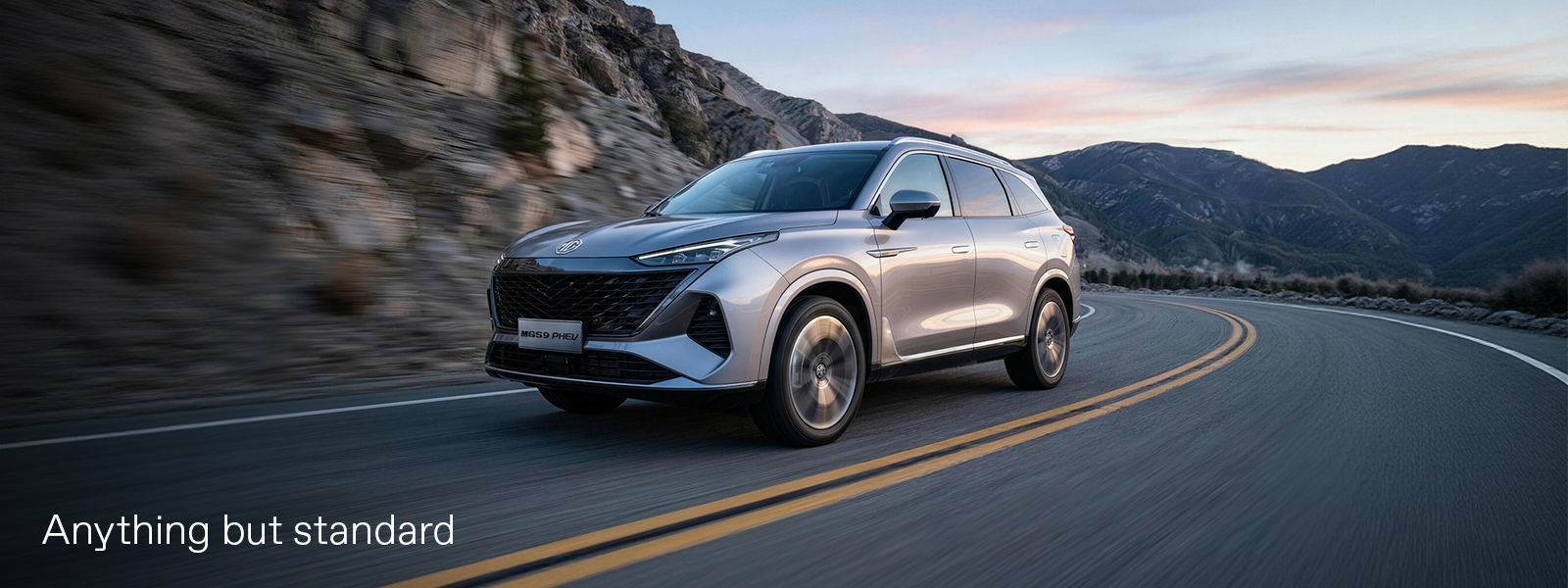
MG S9 PHEV review: Can the MGS9 tow? Maximum MG S9 PHEV towing capacity?
The MG S9 PHEV is a large seven-seat plug-in hybrid SUV that places practicality, electric driving capability and value ahead of outright driving excitement. At almost five metres long and weighing around 2.16 tonnes, it is a substantial vehicle, but its large dimensions are put to good use. There is generous passenger space, a genuinely usable third row and considerable luggage capacity when the rear seats are folded.
The S9 is powered by a 1.5-litre turbocharged petrol engine combined with a 231-hp electric motor. Total system output is 299 hp, with 390 Nm of torque. The electric motor gives the SUV immediate response from low speeds, while the petrol engine provides the range required for longer journeys once the battery charge has been depleted.
The quoted 0–100 km/h time is 9.6 seconds, which gives a good indication of the S9's character. It is not intended to be a performance SUV. Instead, the powertrain provides enough performance to make a fully loaded vehicle feel reasonably effortless. Overtaking is straightforward, and the electric motor gives the S9 a particularly smooth response in urban driving.
The plug-in hybrid system
One of the S9 PHEV's most important features is its 24.7-kWh battery, of which approximately 23.2 kWh is usable. This is a substantial battery for a plug-in hybrid and gives the S9 an official electric range of up to around 100 km.
Actual electric range will depend heavily on conditions. Temperature, road speed, heating or air-conditioning use, passenger load and driving style can all have a significant effect. A real-world range of approximately 50–70 km is a more realistic expectation for mixed everyday driving, although longer distances are possible under favourable conditions.
This gives the S9 a significant advantage for drivers who regularly charge at home. A considerable proportion of normal commuting, school runs and local journeys can be completed without starting the petrol engine.
Once the battery is depleted, the S9 becomes much more dependent on its petrol engine. The official weighted PHEV consumption figure is extremely low because it incorporates electric driving, but that figure should not be interpreted as the expected fuel consumption on a long journey with an empty battery. Real-world petrol consumption in charge-sustaining operation is more likely to be around 7–8 l/100 km, with higher consumption possible at motorway speeds or when towing.
The 65-litre fuel tank helps compensate for the increased consumption during long journeys. The S9 can therefore cover substantial distances without depending on charging infrastructure.
Charging
The S9 supports AC charging at up to 11 kW, allowing the battery to be replenished relatively quickly when connected to a suitable charging system. A full charge can take approximately three hours under favourable conditions.
There is no DC fast-charging capability. For a plug-in hybrid, this is not necessarily a major disadvantage because the normal charging pattern is expected to involve overnight charging at home or charging while parked at work rather than repeated high-power charging during long-distance journeys.
Interior space
The S9's large exterior dimensions provide a major advantage inside the cabin. The second row offers generous legroom and headroom, while the third row is considerably more usable than the occasional seats found in many seven-seat SUVs.
The third row is still better suited to children and smaller adults for extended journeys, but the available space is sufficient for adults when necessary. The seating position is relatively low, which can make long periods in the rearmost seats less comfortable for taller passengers.
Luggage capacity is naturally restricted when all seven seats are occupied. Folding the third row, however, produces a much more substantial cargo area, while folding both rear rows creates a large load compartment suitable for bulky equipment, luggage and other family cargo. Need to carry more, be sure to increase the MG S9’s functionality by fitting a towbar.
This combination of seven seats and substantial cargo capacity is one of the S9's strongest practical attributes.
Comfort and driving characteristics
The S9 has been designed primarily for comfort. Its suspension is relatively soft, and the vehicle is most convincing when driven smoothly rather than aggressively.
Around town, the electric motor and soft suspension give the SUV a relaxed character. The large cabin is quiet, and the substantial dimensions make the S9 feel more like a long-distance family cruiser than a sporty SUV.
The soft suspension can become less convincing when the vehicle is heavily loaded or driven quickly through bends. There can be noticeable body movement under hard acceleration and during rapid changes of direction.
This characteristic becomes particularly relevant when towing. A softer suspension can provide excellent comfort without a trailer, but a heavy caravan introduces additional forces that can make body movement more noticeable. Smooth driving and careful trailer loading are therefore particularly important.
Towing capacity
The S9 PHEV has an official maximum braked towing capacity of 2,000 kg. This is one of its most significant strengths.
The maximum unbraked trailer weight is 750 kg, while the maximum permitted nose weight is 100 kg.
With seven occupants and holiday luggage, the available payload can therefore become a significant consideration.
For a caravan weighing approximately 1,300–1,500 kg loaded, the S9 should have considerable capacity in reserve. A trailer around 1,500–1,700 kg remains a particularly sensible match, provided the caravan is correctly loaded and the vehicle remains within its legal weight limits.
At 1,800–2,000 kg, the S9 is operating much closer to its limits. It is legally capable of towing that weight, but the combination places greater demands on the vehicle's suspension, tyres, brakes and drivetrain, while leaving less payload capacity for passengers and luggage.
The front-wheel-drive limitation
The most important limitation for towing is the S9's front-wheel-drive configuration.
The electric motor produces substantial torque, and on dry roads the front-wheel-drive system is generally adequate. However, a heavy trailer increases the demands placed on the driven front tyres.
This becomes particularly relevant on wet roads, steep inclines, loose surfaces and grassy campsites. Starting a heavy caravan on a slippery incline can produce wheelspin, even with modern traction and stability-control systems.
The absence of all-wheel drive therefore prevents the S9 from being considered an ideal heavy-duty tow vehicle.
This distinction is important because the official 2,000-kg rating is impressive, but towing capacity alone does not determine how capable a vehicle feels with a large trailer attached. Traction, wheelbase, suspension tuning, payload and drivetrain configuration all contribute to the overall towing experience.
For normal road towing with a caravan in the 1,300–1,700 kg range, the S9's characteristics are much less problematic. For frequent towing close to the 2,000-kg limit, particularly on difficult surfaces, an all-wheel-drive alternative may offer greater confidence.
Performance while towing
The electric motor is particularly well suited to pulling away with a trailer because it produces strong torque immediately. The S9 should therefore feel responsive at low speeds even when carrying a substantial load.
The limitation is traction rather than power.
With 299 hp available, there is more than enough power for normal towing. The challenge is putting that power onto the road through the front tyres, particularly when the surface is wet.
Once underway on a dry motorway, the S9's substantial size and weight should provide a reassuring feeling of stability. The vehicle's long wheelbase is beneficial when towing, although the relatively soft suspension means that smooth steering and sensible speeds become increasingly important as trailer weight increases.
Equipment and cabin technology
The S9 is generously equipped, particularly considering its positioning. Depending on specification, equipment includes large digital displays, a panoramic roof, three-zone climate control, heated and ventilated seats, massage functions, a premium audio system, a 360-degree camera, adaptive cruise control and numerous driver-assistance systems.
The cabin therefore delivers a strong sense of equipment and convenience.
The infotainment system is less impressive. The hardware looks modern, but software responsiveness can occasionally be inconsistent. Some functions can feel slower than expected, and occasional connectivity or interface issues have been reported.
Apple CarPlay and Android Auto help reduce the importance of the manufacturer's own interface, but the infotainment system remains one of the areas where the S9 does not quite match the polish of the best-established competitors.
Safety
Safety is another strong point. The S9 achieved a five-star Euro NCAP safety rating, with strong results for adult and child occupant protection as well as its driver-assistance systems.
The extensive suite of electronic safety systems gives the S9 a comprehensive safety package, although some of the driver-assistance functions can be relatively intrusive depending on their settings.
Families should also note that the ISOFIX provision is concentrated in the second row rather than providing mounting points throughout the cabin.
Ownership and reliability
Long-term reliability remains more difficult to assess because the S9 is still a relatively new model. There is not yet the same depth of high-mileage ownership data available for it as there is for more established SUV models.
The warranty provides some reassurance, particularly for the expensive hybrid components and high-voltage battery system.
The greater unknowns concern long-term software reliability, parts availability, dealer support and future resale values. These factors may ultimately determine whether the S9 proves to be as attractive over a long ownership period as it is at the point of purchase.
Overall assessment
The MG S9 PHEV is an unusually capable family SUV because it combines several characteristics that are rarely found together. It has seven usable seats, a large battery, a substantial electric driving range, 299 hp, a 65-litre fuel tank and a 2,000-kg braked towing capacity.
Its greatest strengths are practicality and versatility. A driver who can charge regularly can complete a large proportion of everyday journeys using electric power, while the petrol engine provides the flexibility required for long-distance travel.
The 2,000-kg towing capacity is particularly impressive, but it should be interpreted alongside the S9's 557-kg payload, 100-kg maximum nose weight and front-wheel-drive layout. These factors mean that a 1,300–1,700 kg caravan is a more natural match than a fully loaded 2,000-kg trailer.
For regular heavy towing, especially on wet grass, steep inclines or loose surfaces, the absence of all-wheel drive is the S9's most significant weakness. For ordinary road towing, however, the vehicle has the power, size and official towing capacity to make it a very credible family tow car.
The S9 is therefore best understood not as a dedicated heavy-duty towing machine, but as a large family PHEV that happens to have an unusually strong towing capability. That combination makes it particularly compelling for families that spend most of their time driving without a trailer but need the ability to tow a substantial caravan or trailer when required.
To increase its functionality, be sure to order one of our MG S9 towbars today.


 The tow bar becomes completely invisible - the lines of your car are not spoiled in the slightest.

 Select your Vehicle


