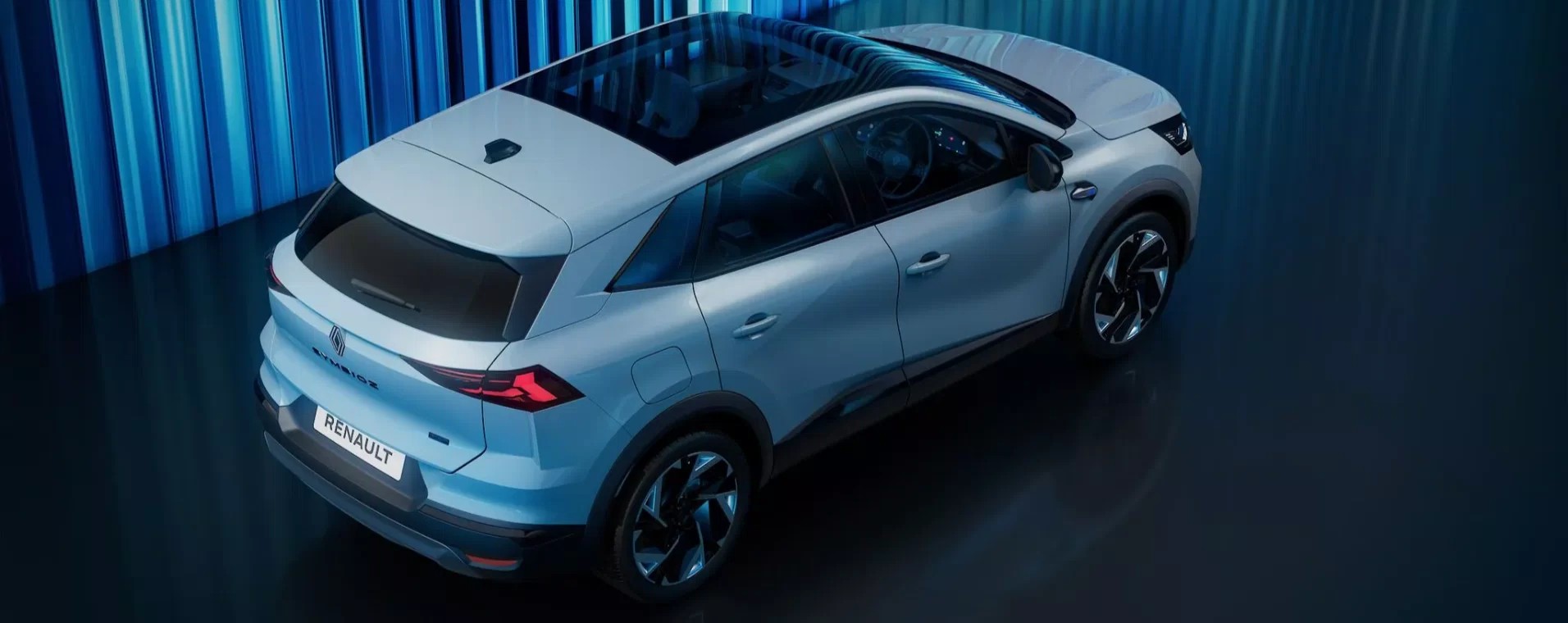
Renault Symbioz: a closer, more thoughtful review. Can it tow?
The Renault Symbioz is an interesting car because it doesn't immediately announce what it is trying to be. It isn't quite a conventional small SUV, because Renault already has the Captur filling that role. It isn't a full-sized family crossover either, because that territory belongs to the Austral and Scenic. Instead, the Symbioz occupies a useful middle ground: it takes the relatively compact footprint of the Captur, stretches the body, adds a considerably more useful rear compartment and boot, and combines it with Renault's latest hybrid technology and infotainment.
And after spending some time looking at what the car is actually trying to accomplish, I think Renault has made a rather sensible product.
The Symbioz is not a car that will win you over because it has extraordinary performance or exceptional driving dynamics. Its appeal is more subtle. It is the kind of car that gradually makes sense the more you think about how you are going to use it. It is relatively compact in town, economical in everyday driving, comfortable enough for a family, surprisingly spacious for its dimensions and equipped with one of the better infotainment systems in the class.
That combination makes it considerably more interesting than its slightly anonymous name might suggest.
The design
Visually, the Symbioz is one of Renault's better-looking practical cars.
The design follows the company's current styling language, with a fairly upright nose, distinctive lighting and a relatively muscular profile. It has enough visual presence to look like a proper SUV without becoming excessively large or aggressive. The long roof and extended rear section are particularly important because they give the Symbioz a useful sense of purpose. You can look at it and immediately understand that Renault has prioritised interior space rather than trying to create another fashionable coupé-SUV.
At the same time, it doesn't look like a stretched Captur. That is important because the two cars share quite a lot underneath the skin. Renault has done enough with the bodywork to give the Symbioz its own identity.
The proportions are probably the strongest part of the exterior. It is 4.41 metres long, which is a very useful size for European roads. It isn't tiny, but it is still substantially easier to manoeuvre and park than many of the larger family SUVs that have become so common.
The more expensive Esprit Alpine version looks particularly attractive, although I would be careful about choosing enormous wheels simply for appearance. The Symbioz is ultimately a practical car, and its ride quality benefits from sensible wheel and tyre combinations.
The interior
Inside, the Symbioz is considerably more impressive than you might expect.
The cabin has the modern Renault feeling that we've seen across the company's newer products, with a large portrait-oriented central screen, a digital instrument display and a dashboard that feels properly contemporary without becoming excessively futuristic.
There are, inevitably, some hard plastics. This isn't a premium SUV and Renault hasn't tried to pretend otherwise. But the areas that you see and touch most frequently are reasonably well finished, and the overall impression is much more sophisticated than the price suggests.
What really separates the Symbioz from many competitors is the infotainment.
Renault's OpenR Link system, built around Google technology, is excellent. Google Maps is integrated into the car rather than being treated simply as something you project from your phone, and the system feels familiar almost immediately. The interface is responsive, the graphics are clear and the whole experience is much closer to using a modern smartphone or tablet than the dated infotainment systems still found in some rival cars.
This is one of those features that sounds relatively insignificant when you're reading a specification sheet but becomes surprisingly important once you live with the car.
The driving position is also good. You sit relatively high without feeling as though you're sitting on top of the car, and the general visibility is good. The physical controls Renault retains for important functions are welcome too. Not everything has been buried inside a touchscreen, which makes the car easier to operate while driving.
The reversing camera is less impressive. Its image quality isn't particularly special, which is disappointing given how good the rest of the technological package is.
The cleverest part of the Symbioz
The best thing about the Symbioz isn't actually the engine or the screen. It is the rear seat.
Renault has fitted the car with a sliding rear bench that can move through a substantial range. This is an extremely simple idea, but it transforms the usefulness of the interior.
If you're carrying passengers, you can move the bench backwards and give them considerably more legroom. If you're travelling with children and need to carry a large amount of luggage, you can move it forwards and make much more room in the boot.
Renault quotes up to 624 litres of boot capacity with the rear bench moved forward and 492 litres with it positioned further back. With the rear seats folded, capacity rises to 1,582 litres.
The important thing isn't really the headline number. It is the flexibility.
A car that can change its interior configuration depending on what you're doing is often more useful in everyday life than a theoretically larger car with a fixed interior.
Of course, there is a compromise. If you move the bench all the way forward to achieve the maximum luggage capacity, rear passenger legroom becomes quite restricted. So you shouldn't think of the 624-litre figure as meaning that you can comfortably carry four or five adults and a gigantic amount of luggage simultaneously.
But for a family of four, it is an extremely useful arrangement.
Towing with the Renault Symbioz
The Symbioz can tow, but it is not really designed as a heavy-duty towing vehicle. This is one area where the car's compact, efficiency-focused character becomes quite apparent.
With the E-Tech full hybrid, the maximum braked trailer weight is around 1,000 kg, while the unbraked limit is typically 750 kg. The exact permitted figures can vary by version, so the individual car's manual are the final authority.
For a small caravan, garden trailer, motorcycle trailer or similar load, that's perfectly usable. A 750–1,000 kg trailer is within its comfort zone, provided you stay within the specific limits for your car.
The more important question is how it tows, rather than simply whether it can.
The E-Tech hybrid has plenty of low-speed torque because of the electric motor, so pulling away with a trailer is actually quite easy. Around town, on a flat road or when manoeuvring onto a campsite, I would expect the Symbioz to feel more capable than its relatively modest power figures suggest.
The situation changes on the motorway.
Once you're towing a significant proportion of the car's maximum permitted trailer weight, the Symbioz's relatively small hybrid powertrain has to work hard. The petrol engine can become quite vocal during acceleration, and the hybrid transmission isn't as natural under sustained heavy load as a conventional automatic transmission in a larger SUV.
This isn't necessarily a problem. It simply means that the Symbioz is better suited to moderate towing rather than regularly hauling a heavy caravan.
A small caravan?
Yes, a lightweight caravan around 800–1,000 kg loaded is much more appropriate than a large family caravan. I'd be comfortable considering something in that territory, assuming the specific car's permitted weights support it.
I'd also pay close attention to the nose weight. With a small hybrid crossover, getting the trailer correctly loaded is particularly important because you don't have the mass and wheelbase of a large SUV to mask a poorly balanced trailer.
But the hybrid isn't perfect
The E-Tech system has one characteristic that is worth understanding before buying the car.
It is at its best when you are driving smoothly.
If you suddenly demand a lot of power, the petrol engine can become quite vocal. The transmission doesn't always behave like a conventional automatic either. Under heavy acceleration, you can get that familiar hybrid sensation where the engine revs rise and the acceleration doesn't quite correspond to the noise.
The newer 1.8 is better than the old 1.6 in this respect, but it hasn't completely eliminated the characteristic.
For ordinary driving, however, I don't think this is a major problem. If you drive the Symbioz like a family crossover rather than a hot hatch, the powertrain is generally very pleasant.
Fuel consumption
Fuel economy is one of the strongest reasons to consider the hybrid.
Renault's official WLTP figure for the E-Tech 160 is around 4.3–4.5 l/100 km depending on specification.
Real life is obviously different, particularly in winter and at motorway speeds. But this is still a car capable of genuinely impressive fuel consumption without requiring you to plug it into anything.
Around town, seeing figures in the region of 4–5 l/100 km is entirely plausible when conditions are favourable. On mixed roads, something around 5 l/100 km is a reasonable expectation. Motorway driving is less spectacular, because once you're travelling at 120–140 km/h the advantages of the hybrid system become smaller and the petrol engine has to do much more work.
This is therefore a car that makes particularly strong financial sense for someone doing a mixture of urban and suburban driving.
If almost all of your driving consists of long motorway journeys, the advantage becomes less dramatic.
On the road
The Symbioz is easy rather than exciting.
The steering is light and the car feels relatively effortless to manoeuvre. That's a positive in a city, although anyone looking for feedback and enthusiasm on a winding road will probably find it somewhat uninspiring.
There is reasonable control of the body through corners, and the car feels secure, but Renault hasn't attempted to give the Symbioz the sort of sharp handling that made some of its older products so entertaining.
That is probably the right decision.
A family crossover doesn't need to be exciting every time you turn a corner. It needs to be predictable, comfortable and easy to place on the road.
And the Symbioz is all three.
Ride comfort is more complicated
This is probably the area where I'd pay particular attention during a test drive.
On good roads, the Symbioz can be perfectly comfortable. At higher speeds it settles down nicely and has a reasonably relaxed character.
Poor urban roads are less impressive.
Sharp potholes, broken tarmac and speed bumps can make the car feel firmer than you'd expect from something marketed primarily as a family crossover. Larger wheels don't help make the Symbioz more attractive, but sensible wheel sizes and higher-profile tyres are likely to.
This is why I wouldn't automatically choose the most expensive version simply because it looks better.
Those big 19-inch wheels certainly make the Symbioz more attractive, but sensible wheel sizes and higher-profile tyres are likely to produce a more pleasant everyday car.
If you live somewhere with poor roads, this is something I'd test carefully before ordering.
Long-distance driving
The Symbioz is perfectly capable of long journeys, but it isn't exceptional at them.
The driving position is comfortable and the hybrid is relaxed when you're cruising. The car has enough performance for motorway overtaking and the newer 1.8 engine is better suited to high-speed driving than the old 1.6.
But there is still more road and wind noise than you'd ideally want.
Under acceleration, the petrol engine can also make its presence known.
This isn't a deal-breaker, but it means I would choose the Symbioz for a mixed driving life rather than specifically for doing huge motorway distances every month.
A larger Qashqai, Kuga or Sportage can feel like the more mature long-distance machine.
Safety
The Symbioz's four-star Euro NCAP rating is probably the biggest objective blemish on the car.
It isn't unsafe. Far from it. The structure performed reasonably well and the car has a substantial amount of modern driver-assistance technology.
But when some competitors achieve five stars, a four-star result inevitably attracts attention.
This isn't something I'd ignore when buying a family car, particularly if you're planning to keep it for many years.
It doesn't automatically rule the Symbioz out, but it does mean that I wouldn't describe it as the unquestionable safety leader in its class.
Reliability and long-term ownership
This is harder to judge because the Symbioz hasn't been around long enough to establish the sort of long-term reliability history that we have developing and deploying its hybrid system for several years, so this isn't a completely experimental power for something like a Toyota Corolla Cross.
The underlying E-Tech technology isn't entirely new, which is reassuring. Renault has been developing and deploying its hybrid system for several years, so this isn't a completely experimental powertrain.
Nevertheless, I'd distinguish between "there are good reasons to expect it to be reliable" and "we know from a decade of ownership data that it is extremely reliable."
The former is currently true. The latter isn't.
If I were buying one new and intended to keep it for a long time, I would seriously consider taking an extended warranty if the price were reasonable.
Which Symbioz makes the most sense?
The basic car can make sense if price is the overriding consideration, but once you're spending serious money on a family crossover, the better infotainment and equipment of the Techno version make the car feel much more complete.
I wouldn't spend a huge amount simply to get the most expensive trim.
The Techno gives you most of what you actually need without turning the car into specification, with sensible wheels and tyres. I'd concentrate on the equipment that actually improves everyday life rather than spending luggage. You get a hybrid that can return very low fuel consumption without ever needing to be plugged in. You get an excellent infotainment system. You get an expensive exercise in option-box ticking.
So, would I buy one?
What makes the Symbioz appealing isn't any one headline feature. It is the way everything fits together.
You get a car that's small enough to live with in the city but large enough to carry a family's luggage. You get a hybrid that can return very low fuel consumption without ever needing to be plugged in. You get an excellent infotainment system. You get a clever sliding rear bench. You get a modern interior and reasonably attractive styling.
The compromises are equally understandable. It isn't particularly sporty. It isn't the quietest car on the motorway. The ride can be firm on bad surfaces, especially with large wheels, and the four-star Euro NCAP rating prevents it from being an obvious class leader.
But those aren't fatal flaws.
The Symbioz is ultimately a car that prioritises living with it rather than impressing you for the first ten minutes. And that is probably its greatest strength.
For someone wanting a reasonably priced family crossover, particularly someone doing a lot of urban and mixed driving, I think the Symbioz E-Tech is one of Renault's most rational products. It doesn't necessarily make the strongest emotional argument, but it makes a very strong practical one.
Overall, I'd give the Renault Symbioz E-Tech about 8/10. It isn't the best car in every individual category, but as a complete package it is unusually well balanced.
To increase its functionality, be sure to fit one of our Symbioz towbars.


 The tow bar becomes completely invisible - the lines of your car are not spoiled in the slightest.

 Select your Vehicle


