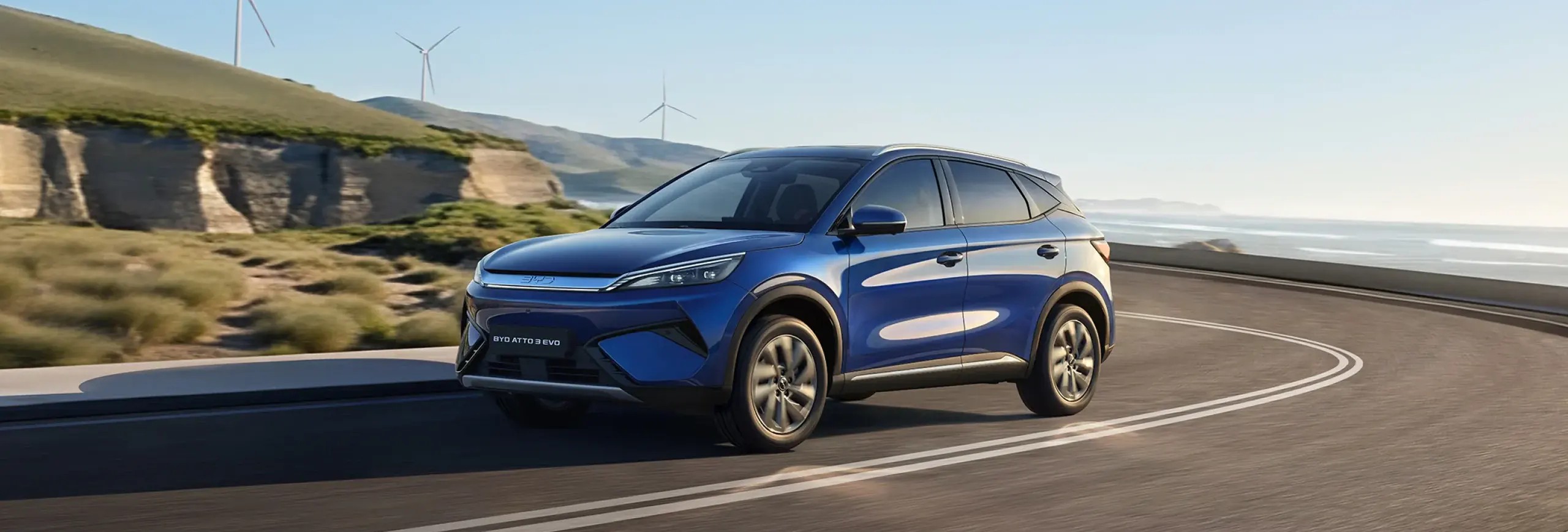
BYD Atto 3 EVO: Comprehensive Review including maximum towing capacity
The BYD Atto 3 EVO represents a substantial evolution of BYD’s compact electric SUV. Rather than simply refreshing the styling of the original Atto 3, BYD has addressed several areas that matter most in everyday electric motoring, including battery capacity, charging speed, performance and practicality.
The result is a more capable family SUV that combines strong acceleration, a modern interior, competitive driving range and considerably faster charging. Its appeal lies in offering much of the technology associated with more expensive electric vehicles in a relatively compact and accessible package.
However, impressive specifications do not necessarily guarantee an outstanding driving experience. Ride comfort, handling, motorway refinement, software usability and long-term reliability are equally important. The Atto 3 EVO makes a compelling case for itself, but there are still areas where its rivals may prove more convincing.
Exterior Design and Styling
The Atto 3 EVO retains the original model’s rounded proportions and contemporary SUV silhouette. Its design is clean and relatively understated, with smooth bodywork, slim lighting elements and a shape intended to balance aerodynamic efficiency with interior space.
At approximately 4.46 metres long, it occupies a useful middle ground between smaller urban electric cars and larger family SUVs. It is substantial enough to provide a spacious cabin while remaining manageable in urban environments and parking garages.
The exterior is modern without being particularly adventurous. Some competing electric SUVs have more distinctive styling, but the BYD's restrained appearance should age reasonably well. It does not rely heavily on dramatic design features that might become dated quickly.
The more significant improvements are beneath the surface. The EVO uses an updated electrical platform and a cell-to-body battery construction, integrating the battery into the vehicle's structure. These engineering changes matter more to the overall driving experience and packaging than the relatively subtle exterior revisions.
Overall, the styling is attractive and functional, although it is unlikely to be the main reason someone chooses the car.
Interior Design and Build Quality
The interior is one of the Atto 3 EVO's more distinctive features. BYD combines a modern digital dashboard with unusual design details and a large central touchscreen. The cabin feels more individual than the minimalist interiors found in some electric vehicles, although personal preferences will determine whether its styling is appealing or unnecessarily elaborate.
The driving position is relatively high, providing the commanding view expected of an SUV. The front seats are designed for everyday comfort, and higher equipment levels offer additional adjustments and convenience features. The overall layout is straightforward once familiarised, although the abundance of touchscreen functions can require some adaptation.
Material quality is generally competitive for the segment. The cabin benefits from thoughtful presentation and generous equipment, but perceived quality is not determined by appearance alone. The feel of the steering wheel, switches, seat upholstery and other frequently touched surfaces is worth assessing during a test drive.
The EVO's underlying packaging is particularly promising. Its 2,720 mm wheelbase provides a useful foundation for passenger space, while the flat floor helps make the rear seating area more accommodating. Adults should find the rear compartment suitable for ordinary family journeys, and the absence of a prominent transmission tunnel makes the middle position more usable than in many conventional petrol vehicles.
The boot offers approximately 490 litres of luggage capacity, supplemented by a 101-litre front storage compartment. This additional space is especially useful for charging cables, small bags and items that drivers prefer to keep separate from their main luggage. Folding the rear seats expands the available cargo area for larger objects.
Taken together, the cabin is practical and well equipped. It is one of the EVO's stronger selling points, particularly for buyers who need a single vehicle to handle commuting, family duties and holidays.
Infotainment and Technology
The centrepiece of the dashboard is a 15.6-inch rotating touchscreen. This is complemented by a digital driver's display, smartphone connectivity, connected navigation and a range of driver-assistance functions.
The rotating screen is an unusual feature that gives the interior a distinctive character. Its practical value is less significant than its novelty, but the large display provides plenty of space for maps, media and vehicle settings. Integrated Google services, where included in the relevant specification, also make navigation and access to familiar applications more convenient.
The broader technology package is competitive. Depending on the market and trim, equipment can include wireless smartphone charging, a surround-view camera, voice control, connected vehicle functions and over-the-air software updates.
The main concern is ergonomics. Large touchscreens look impressive, but they can make frequently used functions less intuitive if those controls are buried in menus. Climate adjustments, regenerative braking settings and driver-assistance preferences are particularly important to test before purchase.
Software responsiveness and interface design also influence the experience over time. A system that initially feels sophisticated can become frustrating if it responds slowly or requires too many steps to perform simple tasks.
The EVO offers an extensive technology package, although its touchscreen-led approach will not appeal equally to everyone.
Performance and Driving Experience
Performance is one of the most significant improvements over the original Atto 3. The EVO is available with rear-wheel drive or dual-motor all-wheel drive, providing buyers with a choice between efficiency and exceptional acceleration.
The Design version produces 313 horsepower and accelerates from 0 to 100 km/h in approximately 5.5 seconds. This is more than sufficient for everyday driving. Overtaking, merging onto motorways and accelerating away from junctions should feel effortless, with the immediate response characteristic of an electric motor.
Rear-wheel drive also gives the Design a potentially more balanced driving character than a front-wheel-drive alternative. Nevertheless, the overall experience depends on suspension tuning, steering calibration and how effectively the car manages its weight.
The Excellence version increases output to 449 horsepower and reduces the claimed 0–100 km/h time to just 3.9 seconds. This is remarkably quick for a compact family SUV and places the vehicle in performance territory that would once have been associated with much more expensive cars.
The dual-motor configuration also provides all-wheel drive, which can improve traction when accelerating on slippery surfaces. This may be useful in wet weather and winter conditions, although suitable tyres remain essential, and all-wheel drive does not automatically improve braking performance.
The question is whether the additional performance translates into a more enjoyable vehicle. For most drivers, the Design's 313 horsepower is already ample. The Excellence is undeniably impressive, but its extra acceleration comes with higher energy consumption and a shorter official range.
Suspension tuning is a more significant consideration. Independent road tests have raised questions about the EVO's ability to absorb broken surfaces smoothly, along with criticisms of its steering feel and body control. Some reviewers have found it comfortable and reassuring in ordinary driving, while others have noted that uneven roads and higher speeds can expose limitations in refinement.
This suggests that the EVO is better understood as a quick, practical family vehicle than a genuinely sporting SUV. Buyers should pay particular attention to ride quality on rough roads, because this will affect everyday comfort far more often than the headline acceleration figure.
Battery, Range and Efficiency
The Atto 3 EVO uses a 74.8 kWh lithium iron phosphate battery, commonly referred to as an LFP battery. Its official WLTP range is up to 510 km for the rear-wheel-drive Design and approximately 470 km for the all-wheel-drive Excellence.
These figures are competitive for a vehicle of this size, although the actual distance available between charges depends heavily on speed, temperature, terrain, heating and driving style.
The Design has an official consumption figure of approximately 16.4 kWh per 100 km, while the Excellence is rated at around 17.8 kWh per 100 km. The difference reflects the additional motor and the greater energy demand associated with the all-wheel-drive configuration.
In everyday mixed driving, a realistic range for the Design may be around 380–430 km in favourable or moderate conditions. Sustained motorway driving can reduce this to approximately 300–350 km. During cold weather, particularly when driving quickly with the cabin heater running, the available range may fall further.
These are planning estimates rather than guaranteed results. Temperature, tyre choice, precipitation, traffic and battery conditioning can all affect consumption.
The Excellence follows the same general pattern but usually delivers less range because of its higher power consumption. Its extra performance is attractive, but buyers who regularly undertake long journeys may find the Design's greater efficiency more valuable.
The LFP battery chemistry is another positive feature. LFP batteries avoid nickel and cobalt in their cathode chemistry and are generally recognised for their durability and thermal stability. However, actual battery longevity depends on cell design, temperature management, charging practices and the vehicle's battery management system.
The EVO's battery capacity is sufficient for the majority of daily driving needs. Its range is competitive, although drivers who frequently undertake very long motorway journeys should consider the combination of real-world consumption and charging opportunities rather than relying exclusively on the official figure.
Charging Performance
Charging is arguably the most important technical improvement in the Atto 3 EVO.
The vehicle adopts an 800-volt electrical architecture and supports peak DC charging power of up to 220 kW. BYD quotes a charging time of approximately 25 minutes for a 10–80% charge under suitable conditions.
This is a substantial improvement over the original Atto 3, whose peak DC charging capability was considerably lower. Faster charging makes the EVO more practical for long-distance travel because it can reduce the time spent waiting at compatible high-power charging stations.
The advertised 25-minute figure should nevertheless be treated as a best-case target. Peak charging power is not maintained throughout the entire charging session. Battery temperature, initial charge level, charger capability and battery conditioning all influence the actual result.
An 800-volt architecture is particularly useful when the vehicle can take advantage of compatible high-power infrastructure. At a slower charging station, the EVO cannot necessarily deliver the full benefit of its technical capability.
For everyday use, the vehicle supports AC charging at up to 11 kW. With a suitable home wallbox, this allows convenient overnight charging. Owners can start most mornings with sufficient energy for commuting and routine errands without needing to visit a public charging station.
The combination of a relatively large battery, efficient everyday driving and faster DC charging makes the EVO a much more versatile long-distance electric vehicle than its predecessor.
Ride Comfort, Handling and Refinement
The driving experience is an area where the EVO's specifications tell only part of the story.
The suspension is intended to balance comfort with the weight and performance of an electric SUV. In normal urban driving, the vehicle should feel easy to operate, with immediate acceleration and a relatively high seating position that provides good visibility.
However, ride quality over uneven surfaces appears less consistently impressive. Broken tarmac, sharp road imperfections and undulating motorway sections can reveal shortcomings in suspension control. This matters because a family SUV is expected to provide relaxed transport rather than simply impressive acceleration.
Steering feel is another consideration. The EVO is easy to drive, but it does not necessarily offer the precision or feedback of the best-handling alternatives. Enthusiastic drivers may find it less engaging than its power figures suggest.
Noise levels also deserve attention. Electric motors are quiet, but wind noise, tyre noise and suspension movements become more noticeable when there is no combustion engine to mask them. At higher speeds, the quality of insulation can significantly influence how comfortable the vehicle feels over a long journey.
The most useful test drive would include uneven urban roads, a faster dual carriageway and a motorway section. It is worth trying both ordinary acceleration and more assertive driving to establish whether the suspension and steering suit your preferences.
The EVO appears competent and reassuring, but comfort and refinement are not areas where it can automatically be assumed to lead its class.
Safety and Driver Assistance
The EVO combines BYD's Blade battery technology with a range of active safety and driver-assistance features. Depending on the specification, these can include autonomous emergency braking, adaptive cruise control, lane-keeping assistance, blind-spot monitoring, traffic-sign recognition and a surround-view camera.
These systems can reduce the workload associated with daily driving. Adaptive cruise control is useful on longer motorway journeys, while a surround-view camera can make parking in tight spaces considerably easier.
Nevertheless, the presence of advanced driver assistance does not guarantee that every system is perfectly calibrated. Some modern vehicles issue frequent warnings or intervene more assertively than drivers prefer. The behaviour of the lane assistance, speed-limit warnings and adaptive cruise control should therefore be assessed during a test drive.
Battery safety is another important part of the picture. BYD's LFP Blade battery is designed with thermal stability and structural integration in mind. These are meaningful engineering advantages, although no battery chemistry eliminates all risks associated with severe impact damage or electrical faults.
The precise crash-test rating and its applicability to the EVO should be verified against the relevant independent assessment for the exact model. It is important not to assume that every version automatically inherits every rating or test result associated with an earlier model.
The safety package is promising, but its real-world value depends on both the vehicle's structural protection and the reliability of its assistance systems.
Running Costs and Overall Value
The Atto 3 EVO can be inexpensive to operate, particularly when most charging takes place at home.
Using an illustrative average consumption of 17.7 kWh per 100 km, electricity priced at 0.20 per kWh in an arbitrary currency unit would cost approximately 3.54 units per 100 km before charging losses. At 0.40 per kWh, the equivalent cost would be 7.08 units. The actual cost depends on the electricity tariff, charging losses and driving conditions.
Home charging usually offers the greatest opportunity to reduce energy costs. Frequent use of expensive public rapid chargers can narrow the advantage over efficient petrol or hybrid vehicles.
Maintenance can also be simpler because an electric drivetrain does not require engine oil changes, spark plugs or many of the other routine services associated with combustion engines. However, tyres, brakes, suspension components, cabin filters, coolant systems and other maintenance items still require attention.
Tyre costs may be particularly relevant for the Excellence because of its power and acceleration. Frequent hard acceleration can increase tyre wear, and the vehicle's weight can also influence running costs.
Depreciation is less predictable. The EVO's competitive specifications and equipment are attractive, but resale value will depend on future pricing, battery confidence, market demand, software support and the pace of development in newer electric vehicles.
The Design is likely to offer the more balanced value proposition for most buyers. It delivers strong performance and competitive range without requiring the additional expenditure or energy consumption associated with the dual-motor version.
The Excellence makes more sense for buyers who genuinely value all-wheel drive, exceptional acceleration and its additional equipment.
Final Verdict
The BYD Atto 3 EVO is a substantial improvement over the original Atto 3 and a convincing entry in the compact electric SUV segment. Its 74.8 kWh LFP battery, 800-volt architecture, 220 kW peak DC charging capability and generous cabin make it a much more complete family vehicle.
Its strongest qualities are its everyday performance, practical interior, modern technology and improved suitability for longer journeys. The Design version in particular offers a compelling combination of acceleration, range and efficiency, while the Excellence provides performance that is exceptional for a vehicle of this type.
Its weaknesses are less obvious on a specification sheet. Ride comfort, steering feel, motorway refinement and the ergonomics of the touchscreen deserve close attention. Long-term reliability and resale value also remain less certain than those of more established models.
For most drivers, the Design is the version that makes the most sense. Its 313 horsepower is already more than sufficient for ordinary use, and its longer official range and lower consumption make it the more rational choice. The Excellence is best reserved for buyers who genuinely need all-wheel drive or place a high value on rapid acceleration.
Ultimately, the Atto 3 EVO is a strong all-round electric SUV rather than an unquestionable class leader. The decisive test is whether its everyday comfort and usability match the impressive engineering beneath the surface.
Towing with the BYD Atto 3 EVO
The BYD Atto 3 EVO is capable of towing a small caravan, a braked utility trailer or a trailer carrying recreational equipment. Its quoted maximum braked towing capacity is up to 1,500 kg, making it more versatile than many compact electric SUVs.
However, the maximum permitted trailer weight is only part of the story. When towing with an electric vehicle, the trailer's weight and aerodynamics can substantially affect range, while the vehicle's permitted nose weight and gross train weight determine which combinations are legally and technically acceptable. Check your owner’s manual. Our towbar is rated for 1500kgs and 150kgs on the ball.
Maximum towing capacity
BYD's official specifications confirm that both versions of the Atto 3 EVO have the same rated towing capacity.
|
Towing specification
|
Capacity
|
|
Maximum braked trailer
|
1,500 kg
|
|
Maximum unbraked trailer
|
750 kg
|
|
Maximum vehicle weight, Design
|
2,410 kg
|
|
Maximum vehicle weight, Excellence
|
2,520 kg
|
The maximum trailer weight refers to the trailer's actual loaded weight, not just its empty weight. You must also remain within the vehicle's permitted gross train weight, axle loads and towbar limits.
What is it like for towing a caravan?
A caravan weighing around 1,200–1,400 kg when fully loaded should be within the EVO's stated braked towing limit, provided the vehicle's other weight limits are respected. A heavier caravan approaching 1,500 kg leaves little margin and requires particular attention to payload, nose weight and stability.
The electric drivetrain is well suited to pulling a trailer away from a standstill. Instant torque makes hill starts and acceleration feel effortless, although the Excellence's additional power is not essential for most towing duties.
The more important limitation is range. Towing increases aerodynamic drag and rolling resistance, particularly with a tall caravan. As a rough planning assumption, expect a reduction of around 30–50% compared with solo driving, potentially more at high motorway speeds or in cold weather. Actual consumption depends heavily on the trailer's shape, weight, speed and wind conditions.
The EVO's fast-charging capability is helpful on longer trips, but towing may require more frequent charging stops. It is worth checking that charging stations along your route have enough space to accommodate the car and trailer without unhitching.
Increase the practicality of your Atto 3 EVO and order our BYD Atto 3 EVO towbar today!


 The tow bar becomes completely invisible - the lines of your car are not spoiled in the slightest.


 Select your Vehicle


