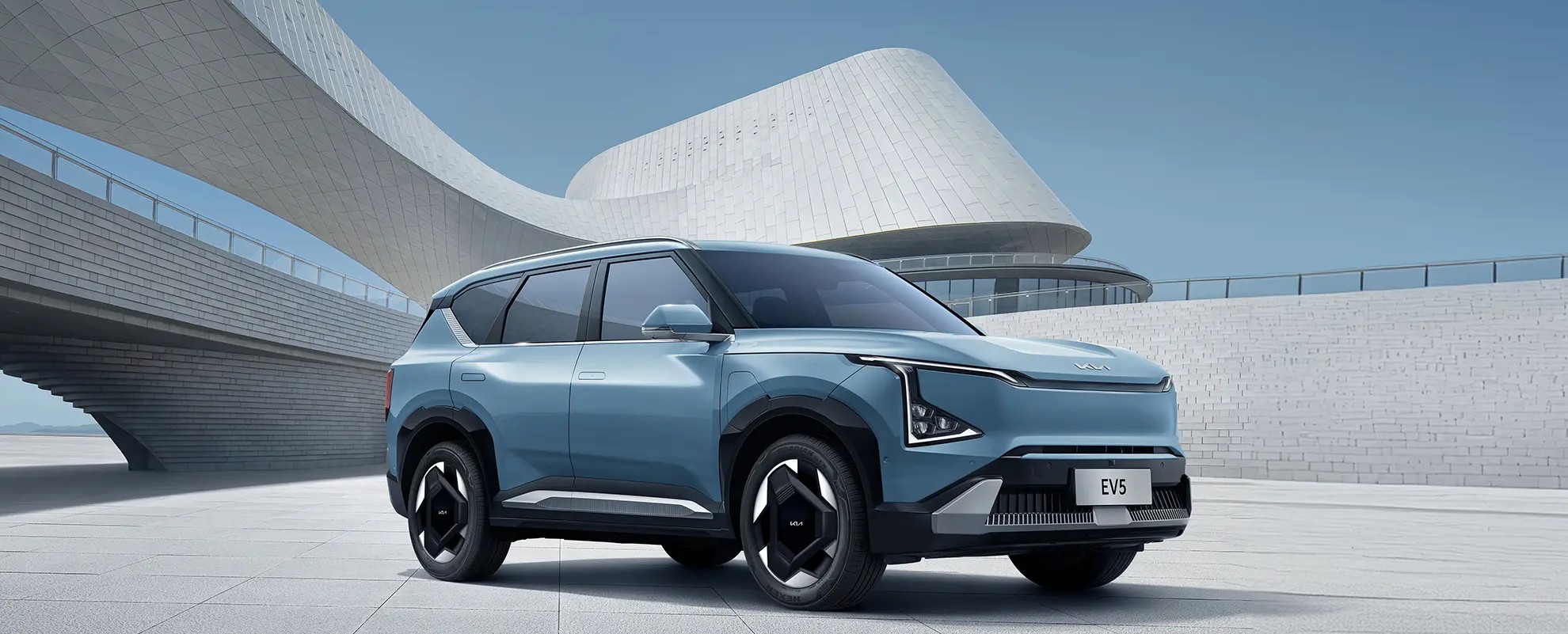
Comprehensive Towing Review: Kia EV5 – can it tow?
The Kia EV5 is one of the most important EVs Kia has launched so far — not because it’s the fastest or most luxurious, but because it targets the center of the global family-car market. Think of it as the electric equivalent of the Kia Sportage: practical, spacious, easy to live with, and priced below premium rivals.
Positioned between the smaller EV3 and the larger EV9, the EV5 competes directly with vehicles like the Tesla Model Y, Volkswagen ID.4, Hyundai Ioniq 5, BYD Sealion 7, and Ford Mustang Mach-E.
Quick Verdict
What the EV5 does exceptionally well
- Outstanding family practicality
- Comfortable ride and upright seating position
- Clean, thoughtful interior ergonomics
- Excellent packaging and cabin space
- Strong value relative to European rivals
- Good range for daily use and road trips
- Traditional SUV feel many buyers prefer over “coupe EVs”
Where it falls short
- Charging speed trails Hyundai/Kia’s best EVs
- Front-wheel-drive versions are not especially exciting
- Infotainment software is merely good, not class-leading
- Efficiency isn’t segment-leading
- Styling may feel too conservative or boxy
- Some markets price it close to the superior EV6
Design & Exterior
The EV5 looks like a scaled-down EV9. That’s deliberate.
Kia avoided the aerodynamic “egg-shaped EV” design trend and instead gave the EV5:
- squared-off proportions
- upright glasshouse
- chunky SUV stance
- sharp geometric lighting
- short overhangs
The result is a vehicle that looks more rugged and practical than many rivals.
Design strengths
- Excellent visibility
- Feels like a real SUV rather than a hatchback on stilts
- Distinctive front and rear lighting signatures
- Premium-looking GT-Line trims
Design weaknesses
- Aerodynamics are compromised compared to sleeker rivals
- Some reviewers find it visually generic
- Less dramatic than EV6 or Ioniq 5
If you like the EV9 aesthetic but don’t want a massive SUV, the EV5 hits a sweet spot.
Interior & Cabin Experience
This is arguably the EV5’s strongest area.
Kia designed the cabin around usability rather than gimmicks.
Highlights:
Seating position
The upright driving position feels natural immediately. Many people moving from SUVs love this.
Physical controls
Unlike some EV rivals, Kia retained:
- proper climate buttons
- steering wheel controls
- tactile shortcuts
That dramatically improves usability while driving.
Space
The EV5 is extremely roomy for its footprint:
- generous rear legroom
- flat floor
- wide-opening doors
- large cargo area
- practical storage solutions
Boot capacity is around 566 liters, expanding to roughly 1,650 liters with seats folded. Need to carry more? Be sure to fit one of our towbars.
Towing with the KIA EV5:
The Kia EV5’s character suits towing better than many sleeker electric crossovers because it was designed as a practical upright SUV rather than a sporty aerodynamic coupe-SUV. The higher seating position, squared-off rear, stable wheelbase, and substantial battery weight low in the chassis all contribute to a calm and predictable towing experience.
The first thing to understand is that the EV5 is not a heavy-duty tow vehicle. Depending on market and drivetrain, most versions are rated to tow somewhere around 1,250 to 1,600 kilograms with brakes. That places it in the category of recreational towing rather than serious commercial hauling. Small campers, compact caravans, utility trailers, motorcycles, bicycles, and small boats are all realistic use cases. Large caravans, horse trailers, or heavy equipment are outside its intended comfort zone.
Where the EV5 should feel especially good is at low speeds. Electric vehicles have a major advantage when towing because they deliver torque instantly and smoothly. Pulling away from a stop is effortless, hill starts are easy, and reversing a trailer tends to feel more controlled than with a traditional gasoline or diesel automatic. Many people who tow occasionally actually find EVs less stressful because there is no gear hunting, turbo lag, or transmission hesitation.
The EV5’s weight also helps stability. EVs carry their batteries under the floor, which lowers the center of gravity dramatically compared with combustion SUVs. That usually reduces trailer sway and gives the vehicle a more planted feel at motorway speeds. In windy conditions or during lane changes, that extra stability can make towing feel more relaxed and confidence inspiring.
The biggest compromise is range. Towing affects EV range much more severely than many first-time EV buyers expect. A small low trailer may reduce range by roughly 20–30 percent, while a caravan or tall camper can easily cut range in half. Aerodynamics matter more than trailer weight. A boxy caravan creates huge drag at highway speeds, and EV efficiency collapses once air resistance rises. If the EV5 normally delivers around 400 kilometers of realistic mixed driving range, towing a medium caravan may reduce that to roughly 220–280 kilometers, especially in cold weather or at motorway speeds.
Charging becomes the second major issue. The EV5 uses a 400-volt electrical architecture rather than the faster 800-volt system found in vehicles like the Kia EV6 and Hyundai Ioniq 5. In practice, that means charging stops are respectable but not exceptional. Under good conditions, charging from 10 to 80 percent generally takes around half an hour. During normal driving that is manageable. While towing, however, charging stops become more frequent and more noticeable because your effective range is much shorter.
Infrastructure is another real-world complication. Many public chargers were not designed with trailers in mind. Often the driver must unhitch before charging or occupy multiple bays awkwardly. Europe is improving rapidly in this area, but towing infrastructure for EVs still lags behind what diesel owners are accustomed to.
For occasional towing, especially weekend camping or leisure use, the EV5 should perform very well. The calm ride quality, quiet cabin, and smooth torque delivery suit relaxed touring. It will probably feel more refined than many combustion crossovers during short and medium-distance towing. It also benefits from regenerative braking on downhill grades, which reduces brake wear and can make mountain descents feel more controlled.
If towing is going to be a major part of ownership, the all-wheel-drive version is clearly the one to choose. The additional traction and power reserve make a noticeable difference when climbing hills, launching boats, or driving in wet conditions. Front-wheel-drive versions are likely sufficient for light trailers but may feel strained with heavier loads.
Compared with rivals, the EV5 occupies an interesting middle ground. The Tesla Model Y is likely more efficient while towing and benefits from Tesla’s charging ecosystem, but many drivers prefer Kia’s more traditional cabin layout and ride comfort. The Kia EV6 charges much faster and has stronger performance, but the EV5’s more upright SUV shape makes it the more naturally practical towing vehicle. Against diesel SUVs, the EV5 loses on long-distance convenience and refueling speed but wins on smoothness, refinement, and low-speed drivability.
Overall, the EV5 looks well suited to people who tow occasionally rather than constantly. If your idea of towing is a weekend trailer, bikes, a small camper, or a lightweight caravan, it should be a pleasant and capable vehicle. If your lifestyle involves frequent long-distance towing through rural areas with limited charging infrastructure, a diesel SUV or a faster-charging EV platform would still make life easier.
Kia EV5 Weaknesses:
Infotainment
The software is competent but not class-leading.
Some reviewers criticize:
- menu complexity
- occasional lag
- less polished UX than Tesla or newer Chinese competitors
TechRadar specifically noted Kia’s infotainment system as the vehicle’s biggest weakness.
Minimal emotional character
The interior is highly functional but not especially exciting or sporty.
Performance & Driving Dynamics:
Powertrain
Most global EV5 versions use:
- 81.4 kWh battery
- ~214 hp / 160 kW motor
- Front-wheel drive
- 0–100 km/h in roughly 8–8.5 seconds
An AWD GT version is emerging in some markets with over 300 hp.
Battery, Range & Charging:
Range
Most long-range versions deliver:
- around 505–530 km WLTP
- realistic mixed driving: ~350–430 km
- highway winter range: potentially 250–320 km depending on climate
The range is competitive but not groundbreaking.
Charging
The EV5 uses a 400V architecture rather than the faster 800V setup found in the EV6 and Ioniq 5.
That matters.
DC fast charging
Typical:
- 10–80% in ~30 minutes
- peak charging around 150 kW
That’s respectable but no longer class-leading.
Technology & Features:
Strong areas
- Large panoramic display
- Excellent driver assistance suite
- Adaptive cruise control
- Digital key support
- Vehicle-to-load (V2L) capability in many trims
- OTA updates
- Strong safety systems
Advanced features on higher trims
- 360 camera
- ventilated seats
- Harman Kardon audio
- panoramic roof
- fingerprint authentication
- massage seats (market dependent)
Real-World Ownership Experience
Strengths:
Reliability
Kia’s EV platform reputation is currently strong.
The company also offers long warranties in many markets:
- often 7 years vehicle warranty
- 8 years battery warranty
Running costs
Expected to be relatively low:
- efficient enough
- low maintenance
- affordable charging at home
Family usability
This is arguably the EV5’s killer feature.
Owners repeatedly praise:
- practicality
- easy ingress/egress
- child-seat friendliness
- visibility
- comfortable seating
Who Should Buy the EV5?
The EV5 makes the most sense for buyers who want:
- a practical family EV
- traditional SUV ergonomics
- comfortable daily driving
- solid range
- good value
- easy transition from ICE vehicles
It is less ideal for buyers prioritizing:
- ultra-fast charging
- sporty driving
- cutting-edge software
- maximum efficiency
Final Assessment
Overall Rating: 8.5/10
The EV5 isn’t revolutionary.
It’s something arguably more important: sensible.
Kia focused on making an EV that normal SUV buyers can immediately understand and comfortably live with. That means:
- practical packaging
- usable controls
- family-friendly space
- comfortable ride
- competitive range
The compromises are real:
- slower charging than EV6/Ioniq 5
- average infotainment
- limited excitement factor
But for many buyers, especially families, those tradeoffs are acceptable.
The EV5 may end up being one of the most commercially important EVs of the decade because it feels less like “an electric experiment” and more like a genuinely good everyday SUV that just happens to be electric.
Want to increase the practicality of your EV5, be sure to fit one of our KIA EV5 towbars today!


 The tow bar becomes completely invisible - the lines of your car are not spoiled in the slightest.

 Select your Vehicle


