Geely Starray – Comprehensive Review – can the Starray tow, need a Geely Starray towbar?
The Geely Starray represents an important step in the evolution of Chinese automotive manufacturing and its growing ambitions in the European market. Once associated primarily with affordable vehicles offering basic equipment and relatively conventional engineering, Chinese manufacturers have increasingly shifted their focus towards sophisticated design, electrification, advanced technology and improved build quality. The Starray is a clear example of this transformation, combining contemporary styling, a spacious interior, extensive equipment and a modern plug-in hybrid powertrain in a package designed to compete with established European, Japanese and Korean SUVs.
Known as the Geely Boyue L in its domestic Chinese market, the Starray is positioned within the increasingly competitive family SUV segment. Its overall concept revolves around delivering a substantial amount of technology, comfort and practicality without entering the premium price territory occupied by more established manufacturers. Rather than competing solely on affordability, Geely has attempted to create a vehicle that can stand on its own merits in terms of design, engineering and everyday usability.
The European-market Starray EM-i is particularly interesting because of its plug-in hybrid configuration. Combining a petrol engine with electric propulsion, it aims to offer the benefits of electric driving during shorter journeys while retaining the flexibility of conventional combustion-engine operation for longer distances. This combination makes the Starray especially relevant to European buyers who are considering electrification but are not yet prepared to transition to a fully electric vehicle.
Although the Starray presents a convincing overall package, its success will ultimately depend on more than its equipment list and competitive pricing. Long-term reliability, driving refinement, dealer support and residual values will all influence its position in the European market.
Exterior Design and Styling
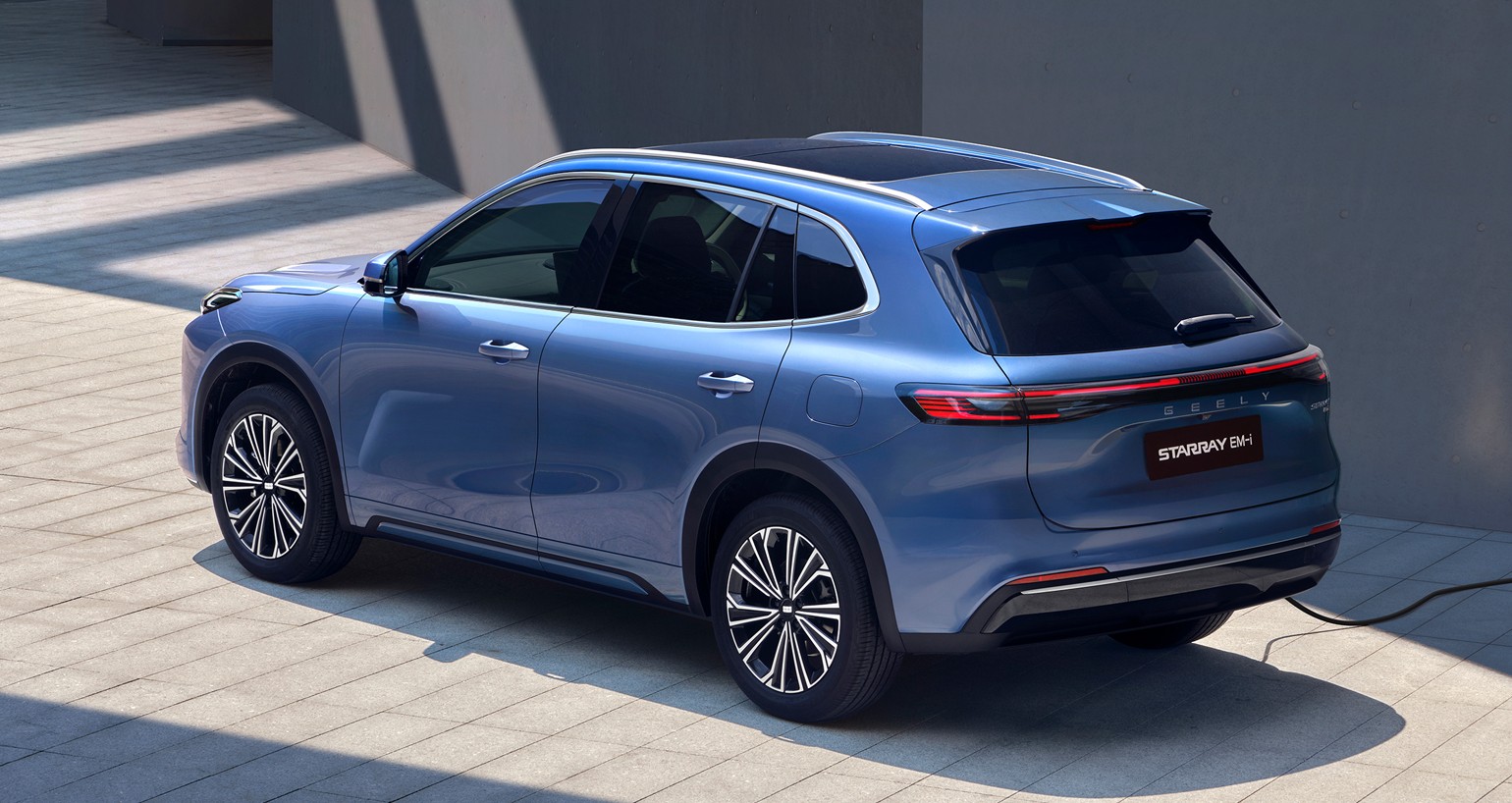
The exterior design of the Geely Starray is one of its most immediately appealing characteristics. It adopts a contemporary design language that combines sharp geometric details, carefully sculpted bodywork and distinctive lighting elements. The result is an SUV that looks modern, substantial and considerably more expensive than its positioning might initially suggest.
The front end establishes a strong visual identity. A prominent grille design is complemented by slim lighting elements and distinctive vertically arranged daytime running lights, creating a recognisable appearance. The bonnet has a relatively high profile, while the sculpted front bumper incorporates angular details that reinforce the vehicle's confident stance. The overall design is somewhat futuristic, reflecting the direction taken by many modern Chinese manufacturers.
Viewed from the side, the Starray benefits from well-balanced proportions. Its relatively long wheelbase and substantial bodywork create an impression of size and solidity, while the rising shoulder line adds visual dynamism. The gently sloping roofline introduces a degree of sportiness without significantly compromising the vehicle's overall SUV character. Depending on the specification, attractive alloy wheels and contrasting exterior details further enhance its appearance.
The rear design continues the contemporary theme, featuring a distinctive lighting arrangement extending across the tailgate and a sculpted rear bumper. The styling is visually coherent, although some elements are more expressive than necessary. This approach may appeal to buyers who appreciate modern and distinctive vehicles, while those who prefer understated European styling may find the design slightly extravagant.
Overall, the exterior represents a successful combination of modernity and practicality. The Starray does not appear visually compromised by its relatively accessible price positioning, and its proportions give it a convincing presence within the family SUV segment.
Interior Design, Materials and Build Quality
The interior is arguably one of the strongest aspects of the Geely Starray. The cabin adopts a minimalist design philosophy, with a clean dashboard layout, a large central infotainment display and a strong emphasis on digital functionality. Its overall appearance is contemporary and sophisticated, creating an environment that feels considerably more premium than the vehicle's price positioning might suggest.
The dashboard has a relatively uncluttered design, while the centre console provides a substantial and visually prominent focal point. The instrument display and central touchscreen contribute to the modern atmosphere, and the overall arrangement reflects the increasing influence of digital technology in contemporary automotive interiors.
Material quality is generally impressive. Soft-touch surfaces, attractive decorative elements and carefully integrated trim create a pleasant environment for occupants. Nevertheless, the distinction between visual presentation and genuine material quality remains important. While many frequently touched areas feel well finished, harder plastics are present in less visible sections of the cabin. This is not unusual within the segment, although buyers familiar with the interior quality of higher-specification Volkswagen, Mazda or Hyundai models may notice differences in certain details.
The seats are designed primarily around comfort rather than sporty support. Their shape and adjustment possibilities provide a relaxed driving position, while the elevated seating arrangement offers the commanding road view expected from a modern SUV. Depending on the specification, electrically adjustable seats and additional comfort features further improve the overall experience.
The infotainment system is a particularly prominent feature. Its large central touchscreen provides access to navigation, entertainment, vehicle settings and numerous convenience functions. The graphics are modern, and the presentation gives the cabin a technologically advanced character.
However, the extensive reliance on touchscreen controls also introduces certain disadvantages. Functions that could be accessed more conveniently through physical switches are sometimes integrated into digital menus. Adjusting climate settings or changing certain vehicle preferences can therefore require additional attention, particularly while driving. Although the system contributes to the cabin's modern appearance, its practical operation may not satisfy drivers who prefer conventional controls.
The overall interior experience is therefore a combination of impressive presentation, generous equipment and a few ergonomic compromises. It does not quite reach the material consistency of established premium manufacturers, but it provides a convincing level of sophistication for its market segment.
Space, Comfort and Practicality
Passenger accommodation is another area in which the Starray performs convincingly. Its relatively generous exterior dimensions and long wheelbase translate into a spacious passenger compartment, particularly in the rear.
Front occupants benefit from a comfortable seating position, good headroom and a commanding view of the road. The elevated driving position makes the vehicle easy to enter and leave, while the overall cabin layout creates a relatively airy atmosphere. The available adjustments also allow drivers of different heights to establish a comfortable position behind the steering wheel.
Rear passenger accommodation is particularly competitive. Legroom is generous, and headroom is sufficient for adult occupants. The rear bench provides a comfortable seating arrangement for longer journeys, while the relatively flat floor improves accommodation for passengers occupying the middle seat.
For family use, these characteristics are particularly important. The Starray offers sufficient room for adults travelling in the rear, while the spacious cabin provides practical flexibility for child seats and everyday family transport.
Storage solutions are distributed throughout the interior, with useful compartments, cupholders and door pockets contributing to everyday convenience. The centre console also provides additional storage space, although the exact arrangement varies according to specification.
The luggage compartment offers approximately 428 litres of capacity in the EM-i configuration, expanding to around 2,065 litres with the rear seats folded. This provides sufficient room for everyday shopping, luggage and general family requirements.
Although some competitors offer larger luggage compartments, the Starray remains a practical family vehicle. The plug-in hybrid battery also influences packaging, making the available luggage capacity particularly relevant when comparing it with conventional petrol SUVs.
Ride comfort is generally oriented towards relaxed everyday driving. The suspension is designed to absorb ordinary road imperfections and maintain a comfortable environment in urban areas and on longer journeys. However, sharper road imperfections can expose a slightly firm suspension response, while body movements become more noticeable when driving through corners at higher speeds.
The Starray therefore prioritises passenger comfort and practicality rather than dynamic precision. For families and commuters, this approach is entirely appropriate.
Engine, Hybrid Technology and Performance
The Geely Starray EM-i is equipped with a plug-in hybrid powertrain combining a 1.5-litre naturally aspirated petrol engine with an electric motor and a dedicated hybrid transmission. The combined system produces 193 kW, equivalent to approximately 262 horsepower, with power delivered to the front wheels.
This configuration is important because international versions of the Starray can feature different engines and transmission arrangements. Specifications advertised in China or other overseas markets should therefore not automatically be applied to the European EM-i model.
The hybrid system has been developed primarily around efficiency and smooth everyday operation rather than outright sporting performance. The electric motor provides immediate torque, allowing the vehicle to move away from a standstill smoothly and respond promptly to accelerator inputs. This characteristic is particularly noticeable in urban environments, where frequent acceleration and deceleration make electric propulsion especially useful.
The combined output of 262 horsepower provides respectable performance for a family SUV. Acceleration from 0 to 100 km/h takes approximately 8.1 seconds, which is sufficient for everyday driving, motorway entry and normal overtaking manoeuvres.
The petrol engine produces 73 kW, while the electric motor contributes much of the system's responsive character. The dedicated hybrid transmission coordinates the two power sources according to driving conditions and energy requirements. Its operation differs from that of a conventional multi-speed automatic gearbox, as the system is designed around the interaction between combustion and electric propulsion.
During electric driving, the Starray is particularly pleasant. Acceleration is smooth, engine noise is absent and the general driving experience becomes noticeably more relaxed. This is arguably the powertrain's greatest strength.
When the battery charge becomes depleted or additional power is required, the petrol engine becomes more involved. Under moderate driving conditions, the transition between electric and combustion operation is generally acceptable. However, heavier acceleration can make the engine more noticeable, and its sound becomes less refined when working at higher loads.
This is one area where the Starray does not quite match the refinement of the most accomplished hybrid systems from manufacturers such as Toyota and Hyundai.
Nevertheless, the powertrain offers a sensible balance between performance and efficiency. The Starray is not designed to be a sporting SUV, but its combined output provides sufficient power for most driving situations.
Battery, Electric Range and Fuel Consumption
The plug-in hybrid system is central to the Starray's appeal. Unlike a conventional self-charging hybrid, the EM-i features an externally rechargeable battery that allows the vehicle to complete a significant proportion of everyday journeys using electric power alone.
The Geely is equipped with an 18.4 kWh battery, providing an official WLTP electric driving range of up to 83 kilometres. This is a competitive figure within the family SUV segment and makes the vehicle particularly attractive to drivers undertaking regular shorter journeys.
In practical terms, the available electric range can cover many daily commutes, shopping trips and school runs without requiring petrol consumption. However, achieving the official figure depends on several factors, including ambient temperature, driving style, road conditions, vehicle speed and the use of heating or air conditioning.
Low temperatures, cabin heating, wet roads and increased rolling resistance can reduce electric range considerably. Consequently, the actual distance available on a full charge during winter is likely to be noticeably lower than the official WLTP figure.
The ability to charge at home or at work is therefore a major advantage. Regular charging allows the vehicle to operate predominantly as an electric car during shorter journeys, while the petrol engine provides flexibility for longer trips.
Geely quotes weighted combined fuel consumption of approximately 2.4 litres per 100 kilometres under WLTP testing. This figure should be interpreted carefully, as plug-in hybrid testing methodology assumes a proportion of driving takes place with a charged battery. It should not be considered representative of continuous driving with a depleted battery.
The official combined petrol consumption figure is approximately 6.2 litres per 100 kilometres under the relevant testing cycle. Actual consumption will depend on driving conditions and the extent to which the battery is regularly recharged.
For drivers who undertake frequent motorway journeys without charging opportunities, the financial advantage of the plug-in hybrid system becomes less significant. In such circumstances, the vehicle operates more frequently with the petrol engine contributing to propulsion, reducing the benefits associated with electric driving.
The Starray therefore makes the strongest economic case when used by households with convenient access to charging facilities and predictable daily driving patterns.
Driving Experience and Road Behaviour
The driving character of the Geely Starray reflects its primary purpose as a comfortable family SUV. It is relatively easy to operate, offers sufficient performance and provides a relaxed driving experience during everyday journeys.
In urban environments, the electric motor gives the vehicle a smooth and responsive character. Moving away from traffic lights is effortless, and the absence of conventional engine noise during electric operation contributes to a more refined atmosphere. The automatic transmission also makes the vehicle straightforward to drive in congested traffic.
The elevated seating position provides good visibility, while the steering is light enough to make manoeuvring relatively easy. Parking is further assisted by the availability of a 360-degree camera in the relevant specifications.
On country roads, the Starray demonstrates a more conventional character. Steering response is relatively light and does not communicate particularly detailed information about the road surface. Although this is perfectly acceptable for everyday driving, it does not create an especially engaging driving experience.
The suspension prioritises comfort and stability rather than sporty handling. During normal driving, the vehicle remains predictable, but more enthusiastic cornering reveals noticeable body movements. Compared with some of the better European competitors, its suspension calibration could benefit from greater composure.
The front-wheel-drive configuration is entirely appropriate for normal road use, although it limits the vehicle's suitability for demanding off-road conditions. Despite its substantial SUV appearance, the Starray should primarily be considered a road-oriented family vehicle rather than a serious all-terrain model.
Motorway driving is generally comfortable, and the vehicle has sufficient power for maintaining normal cruising speeds. However, engine noise can become more noticeable during acceleration, and the overall acoustic refinement does not quite match the best established hybrid SUVs.
Driver-assistance systems also influence the overall driving experience. Lane-keeping assistance, speed-limit warnings and driver-monitoring functions provide additional safety, but their interventions can occasionally feel overly sensitive. This can become frustrating on roads with inconsistent markings or where traffic conditions require frequent adjustments.
The general driving experience is therefore competent and comfortable, although it does not establish the Starray as a particularly sophisticated or dynamically engaging SUV.
Safety and Driver Assistance
Safety is one of the most convincing aspects of the Geely Starray. The vehicle achieved a five-star Euro NCAP rating in 2025, demonstrating competitive performance in independent crash testing.
Its assessment produced scores of 90% for adult occupant protection, 87% for child occupant protection, 86% for vulnerable road users and 77% for safety assistance systems.
These results demonstrate that Geely has placed considerable emphasis on both passive and active safety. The passenger compartment performed well during frontal and side-impact assessments, while the child occupant protection results provide additional reassurance for family buyers.
The Starray is also equipped with a comprehensive collection of electronic safety systems. Depending on specification, these include adaptive cruise control, autonomous emergency braking, lane-keeping assistance, blind-spot monitoring, rear cross-traffic alert, driver monitoring and a 360-degree camera.
The availability of this equipment is impressive, particularly when considered alongside the vehicle's relatively competitive pricing.
However, the presence of advanced safety technology does not automatically guarantee an ideal user experience. As with many contemporary vehicles, certain assistance systems can intervene more frequently than some drivers would prefer. The ability to understand and adjust their settings is therefore an important consideration during the ownership experience.
Nevertheless, the five-star Euro NCAP result represents a significant achievement and provides independent evidence of the Starray's competitive safety credentials.
Equipment and Technology
Equipment levels are among the strongest arguments in favour of the Geely Starray. The manufacturer has adopted a strategy of offering a generous collection of comfort, convenience and technology features, reducing the need for expensive optional extras.
The Pro specification includes features such as a large 15.4-inch infotainment display, digital instrument cluster, Apple CarPlay, navigation, a 360-degree camera, adaptive cruise control, electrically adjustable front seats and heated front seats.
The higher Max specification introduces additional equipment, including a head-up display, panoramic roof, upgraded audio system, wireless phone charging and further comfort features. Depending on the exact configuration, the upgraded sound system incorporates 16 speakers, including speakers integrated into the headrests.
This is a particularly generous equipment package. Comparable features in established European manufacturers can often require moving to higher trim levels or purchasing additional equipment packages.
The 360-degree camera is especially useful given the Starray's relatively substantial dimensions. The head-up display also improves convenience by presenting important driving information within the driver's normal field of vision.
However, the technology-heavy approach has certain disadvantages. A large touchscreen may create an impressive first impression, but its practical value depends on software responsiveness, menu organisation and the accessibility of everyday functions.
The infotainment system provides an extensive range of functions, although the reliance on digital controls may not appeal to every driver. Greater integration of physical controls for frequently used functions would improve usability.
Overall, the Starray offers a convincing technology package that compares favourably with many established competitors in its price category.
Dimensions and Luggage Capacity
The Geely Starray measures approximately 4,740 mm in length, 1,905 mm in width and 1,685 mm in height. Its wheelbase measures 2,755 mm, contributing to the generous passenger accommodation.
The luggage compartment offers approximately 428 litres of capacity in the EM-i configuration, increasing to around 2,065 litres when the rear seats are folded.
These dimensions place the Starray firmly within the family SUV category. Its relatively long body creates a substantial road presence, although its width should be considered when parking in older European cities, underground garages and narrow residential streets.
The turning circle of approximately 10.4 metres is reasonable for a vehicle of this size, while the 360-degree camera assists with manoeuvring in confined spaces.
The overall dimensions provide a useful balance between passenger comfort, luggage capacity and everyday usability.
Reliability, Warranty and Long-Term Ownership
Reliability remains one of the more difficult aspects of evaluating the Geely Starray objectively. Geely is a major international automotive group with extensive manufacturing and engineering capabilities, as well as ownership interests in established automotive brands such as Volvo, Polestar and Lotus.
Its access to substantial engineering resources and modern manufacturing technology provides a strong foundation. However, the long-term reliability reputation of the Geely brand itself in Europe is still developing.
There is an important distinction between producing a technologically advanced vehicle and demonstrating consistent reliability over many years of European ownership. The Starray's plug-in hybrid system combines an internal combustion engine, electric motor, high-voltage battery, power electronics and dedicated transmission. This offers considerable flexibility and efficiency, but it also introduces additional components that may require attention as the vehicle ages.
At present, there is insufficient long-term European ownership data to establish a definitive reliability record over eight or ten years. Consequently, claims of exceptional long-term durability would be premature.
The warranty package is reassuring. In Poland, the manufacturer offers a six-year or 150,000-kilometre vehicle warranty, while the traction battery, electric drive motor and associated controller receive eight years or 150,000 kilometres of coverage. A 12-year corrosion perforation warranty is also advertised for the Starray EM-i.
These commitments provide a degree of reassurance, although the detailed warranty conditions, exclusions and servicing requirements should be examined before purchase.
The availability of authorised service facilities and replacement parts is another important consideration. Geely is developing its dealer and service network in Poland, but the convenience of ownership will depend partly on the availability of authorised workshops in individual regions.
Access to software updates, hybrid-system diagnostics and replacement electronic components will be particularly important as the vehicle becomes older.
Residual value also remains uncertain. Established manufacturers such as Toyota, Volkswagen and Hyundai benefit from years of European market recognition and a more developed used-car market. Geely still needs to demonstrate how its vehicles perform in terms of depreciation and second-hand demand.
These considerations do not necessarily indicate shortcomings in the Starray itself, but they represent genuine ownership factors that should be considered alongside its attractive purchase price.
Price and Value for Money
The Geely Starray becomes particularly interesting when its pricing is considered.
Relevant alternatives include the BYD Sealion 5 DM-i, MG HS Plug-in Hybrid and Chery Tiggo 7 PHEV. The Hyundai Tucson Hybrid and Toyota RAV4 also deserve consideration, although their powertrain configurations and pricing structures differ.
Toyota offers an established reputation for hybrid reliability and strong resale values, while Hyundai benefits from a well-developed European dealer network and considerable experience in electrification. BYD and MG provide increasingly competitive alternatives in terms of equipment, technology and pricing.
The Geely's principal advantage is the amount of space, technology, performance and equipment available for the purchase price. Its principal disadvantage is the lack of an equally established European ownership history and residual-value reputation.
Consequently, the Starray's value proposition is strongest when purchased at a competitive promotional price and used in circumstances that allow regular battery charging.
Overall Assessment and Conclusion
The Geely Starray is a convincing example of how rapidly Chinese automotive manufacturers have developed their products and expanded their ambitions in the European market. It combines contemporary styling, a spacious and technologically advanced interior, generous equipment, a capable plug-in hybrid powertrain and a competitive level of safety.
Its strongest qualities are comfort, practicality and value for money. The passenger compartment provides generous accommodation, the equipment list is extensive and the electric driving capability makes the vehicle particularly attractive for everyday commuting. The combined output of 262 horsepower also ensures that performance is entirely adequate for the requirements of a family SUV.
The five-star Euro NCAP rating further strengthens its appeal, demonstrating that the vehicle offers competitive occupant protection and a comprehensive collection of active safety technologies.
Nevertheless, several areas leave room for improvement. The driving dynamics are relatively conventional, steering feedback is limited and the suspension does not provide the same level of composure as the best European competitors. The petrol engine can become noticeably louder under acceleration, while the touchscreen-dependent interface is not always the most intuitive solution.
Long-term reliability and residual values also remain important uncertainties. Although Geely has considerable automotive experience and engineering resources, its European ownership record is still developing. The continued expansion of its service network and the availability of replacement parts will play an important role in establishing customer confidence.
The Starray is particularly suitable for households with access to home or workplace charging, where the majority of daily journeys can be completed using electric power. Under these circumstances, the plug-in hybrid system can provide meaningful fuel savings and a comfortable everyday driving experience. For drivers who regularly undertake long motorway journeys without charging opportunities, its economic advantages are considerably less compelling.
Ultimately, the Geely Starray should be regarded as a serious competitor in the family SUV segment rather than simply an inexpensive alternative to established manufacturers. It does not necessarily outperform every rival in terms of refinement, driving dynamics or long-term ownership confidence, but its combination of technology, space, performance and equipment makes it a highly attractive proposition.
Geely Starray EM-i
8.0/10
Overall editorial assessment
|
Category
|
Rating
|
|
Exterior design
|
8.5/10
|
|
Interior and perceived quality
|
8.5/10
|
|
Passenger comfort and space
|
8.5/10
|
|
Performance and powertrain
|
8.0/10
|
|
Fuel economy potential
|
8.5/10
|
|
Driving dynamics
|
7.0/10
|
|
Safety
|
9.0/10
|
|
Technology and equipment
|
8.5/10
|
|
Reliability confidence
|
7.0/10
|
|
Value for money
|
8.5/10
|
The Geely Starray ultimately demonstrates that the competitive landscape of the European SUV market is changing. Its combination of modern design, electrification, generous equipment and accessible pricing makes it difficult to overlook. While established manufacturers retain advantages in brand reputation, long-term reliability records and resale values, the Starray offers a credible alternative that deserves serious consideration from buyers seeking a well-equipped and spacious family SUV.
In many respects, its greatest achievement is not that it attempts to imitate established European competitors, but that it offers a distinctive combination of features and technology at a price that challenges traditional expectations of what a vehicle in this category should deliver.
In terms of towing, as usual Chinese manufactures are inconsistent.
Depending on your region, your Geely is either rated at zero , 750, or 1050kgs.
Most European models are rated at 750gs max 50-75kgs download.
Earlier Australian Geely E5’s were NOT rated for towing – so our towbar can only be used for a bike carrier.
The current models in OZ offer up to 1,050 kg braked towing on the Inspire AWD and 105kgs download – CHECK YOUR OWNERS MANUAL for the max
Order one of our Geely towbars today to increase your Geely’s functionality.


 The tow bar becomes completely invisible - the lines of your car are not spoiled in the slightest.


 Select your Vehicle


