Is it possible to tow with the new Mini SE J01? Need to take your bikes with you? Have a look at our Mini SE bike towbar
The most important thing to understand is that the J01 SE is the first MINI built on a dedicated EV platform, rather than adapting a combustion chassis. That single decision reshapes everything: proportions, weight distribution, interior packaging, and even the way the car feels in motion. Instead of squeezing batteries into an existing structure—as the old electric MINI did—the J01 lays its 54.2 kWh battery flat under the floor, using the entire wheelbase as a structural energy storage element.
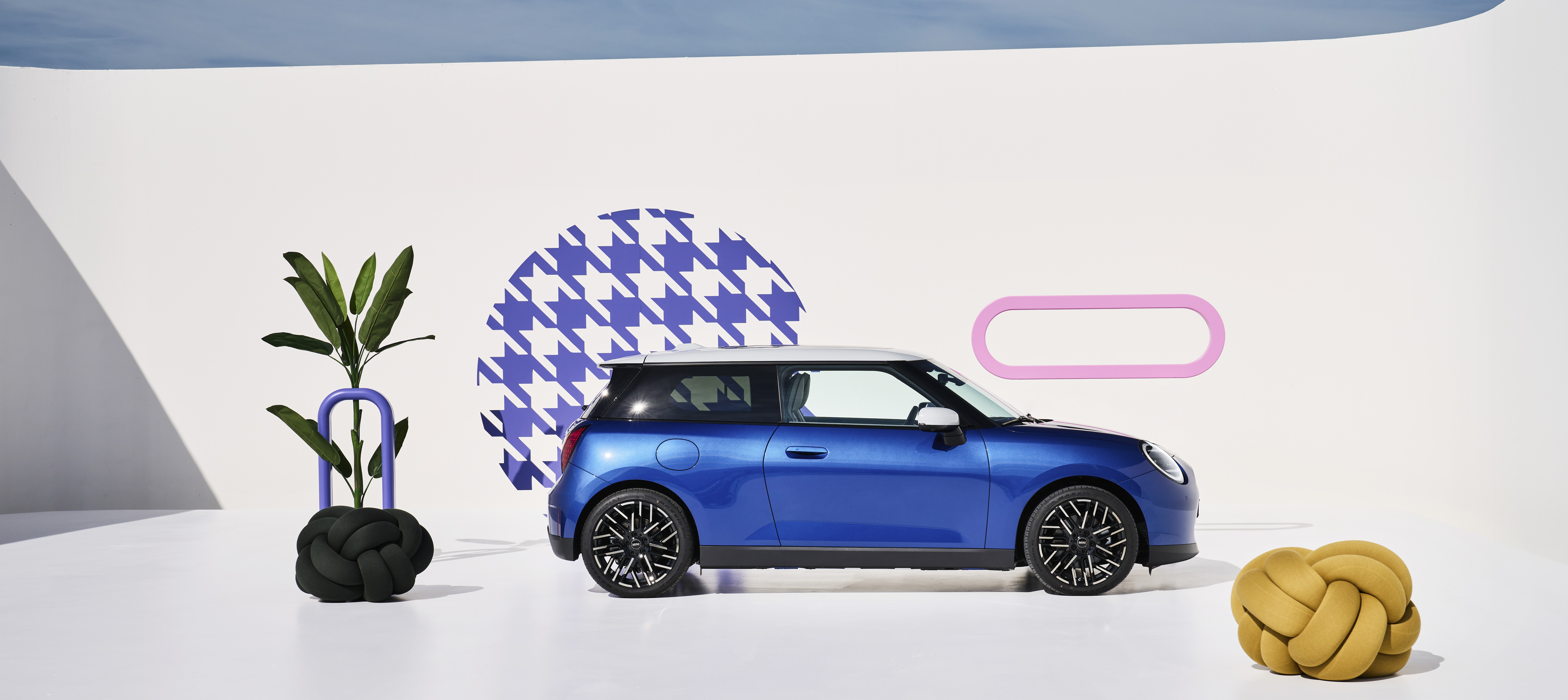
That creates a very different physical presence. The car is still tiny—just under 3.86 meters long—but it’s slightly wider, lower in visual mass, and more planted than previous MINIs.
There’s a subtle shift from “upright, playful object” to something that feels more grounded and architectural. The wheels still sit at the corners, but now the body sits more confidently between them rather than perched on top.
From a design standpoint, the SE is actually the purest expression of the new MINI philosophy. Because it doesn’t need a traditional grille for cooling, the front becomes almost entirely graphic. The hexagonal shape remains, but it’s largely closed off, functioning as a visual anchor rather than a technical necessity. This allows the entire front fascia to be treated like a single design surface, with lighting signatures doing most of the expressive work.
The headlights are particularly important here. They’re no longer just illumination units; they’re part of the car’s identity system. Different “experience modes” subtly alter their appearance, tying the exterior into the digital interior ecosystem. This is something that simply didn’t exist in older MINIs—it’s closer to how consumer electronics behave than traditional cars.
Along the sides, the absence of engine packaging constraints lets the proportions breathe. The dash-to-axle ratio is shorter, the cabin sits slightly more centrally, and the whole car reads as more compact but also more resolved. There’s less visual tension, fewer decorative elements, and a stronger emphasis on clean geometry.
At the rear, the design becomes more abstract. The triangular light signatures and simplified surfaces feel deliberately modern, almost branding-driven rather than function-driven. It’s less about nostalgia now, more about establishing a recognizable visual language for MINI’s electric future.
Inside, the SE is where the conceptual shift becomes unavoidable. The cabin is no longer organized around the driver in a traditional sense; it’s organized around interaction.
Everything revolves around the circular OLED display. It replaces the instrument cluster entirely, meaning there is no dedicated driver binnacle. Speed, navigation, vehicle data—all live in that central disc. This forces a different relationship with the car. You’re not glancing down at gauges; you’re engaging with a shared visual hub.
The material strategy reinforces this shift. The use of textiles—woven surfaces, patterned fabrics, soft-touch composites—gives the interior a tactile, almost domestic quality. It feels closer to industrial design or furniture than to automotive luxury. There’s a conscious move away from leather-heavy, traditional premium cues toward something more contemporary and sustainable.
Yet MINI retains just enough physicality to stop it from becoming purely digital. The toggle switches beneath the screen are still there, and they matter more than ever. They provide a mechanical counterpoint to the screen-heavy interface, grounding the experience in something tactile.
Technically, the SE sits in an interesting place. The single front-mounted motor produces around 218 horsepower and 330 Nm, delivered instantly as you’d expect from an EV.
Acceleration to 100 km/h happens in roughly 6.7 seconds, which on paper isn’t extreme, but in a car this small feels more immediate than the numbers suggest.
What defines the power delivery is not peak output, but linearity and accessibility. There’s no buildup, no shift points, no waiting—just a continuous surge. In urban environments, it feels effortlessly quick, almost elastic.
Range sits around 390–400 km WLTP, which is a massive improvement over the previous electric MINI and finally makes the car usable beyond short commutes.
But charging performance tells a more nuanced story. With peak DC charging around 95 kW, it’s adequate rather than leading, reinforcing the idea that this is still primarily an urban-focused EV rather than a long-distance cruiser.
Being a small EV understandably the J01 Cooper SE has no manufacturer-approved towing capacity. In most markets, it is rated at 0 kg / not approved for towing.
Our solution is a BIKE-ONLY accessory, that allows you to fit a “ball” mounted bike carrier. Max 75kgs on the ball (bike carrier+bikes). Increase the practicality of your Mini SE and enjoy your next weekend away by taking your bikes along.
Where things get especially interesting is how the electric architecture changes the driving experience.
The added weight—around 1.6 tonnes—should, in theory, dilute the classic MINI agility. But because that weight is mounted low in the chassis, the center of gravity drops significantly. The result is a car that feels flat and planted in corners, with very little body roll.
At the same time, the short wheelbase is still there, and it still defines the car’s behavior. Turn-in is immediate, almost abrupt, and the car changes direction eagerly. There’s a sense that the entire mass rotates as a single unit, rather than flexing through the suspension.
However, the limits reveal the constraints of the layout. It’s still front-wheel drive, still relying on electronic torque management, and under hard acceleration out of tighter corners, the front axle can feel overwhelmed. Reviews note that the steering can tug slightly and that grip isn’t always perfectly clean under load.
The suspension tuning is firm, as expected, but slightly more forgiving than older JCW models. The longer wheelbase and heavier mass actually help smooth out some of the harshness, though sharp bumps can still unsettle the car due to limited suspension travel.
One of the most distinctive aspects of the SE is how it replaces traditional sensory feedback with designed experiences.
There’s no engine noise, obviously, so MINI introduces synthetic soundscapes that change with drive modes. Steering weight, throttle mapping, ambient lighting, and even the visual theme of the central display all shift together. The car becomes a kind of multi-sensory interface, not just a machine.
This is where the SE diverges most from older MINIs. It’s not trying to replicate the past—it’s trying to reinterpret the idea of fun in a digital, electric context.
In a broader sense, the 3-door J01 SE feels like a transition object.
It still carries the essential MINI traits:
- compact footprint
- hyper-responsive front end
- playful, slightly exaggerated character
But it expresses them through completely different means:
- software instead of mechanics
- design instead of engineering theatre
- immediacy instead of buildup
It’s less about mechanical interaction and more about cohesion between design, interface, and motion.
And that’s really the key to understanding it. The J01 Cooper SE isn’t trying to be a traditional hot hatch, even in electric form. It’s trying to be a holistic product—a small, fast, visually distinctive object where the driving experience is just one layer of a much broader, carefully designed system.
Increase the functionality of your Mini and fit our bike carrier towbar. Order your Mini J01 bike towbar today – also suits the JCW….


 The tow bar becomes completely invisible - the lines of your car are not spoiled in the slightest.

 Select your Vehicle


