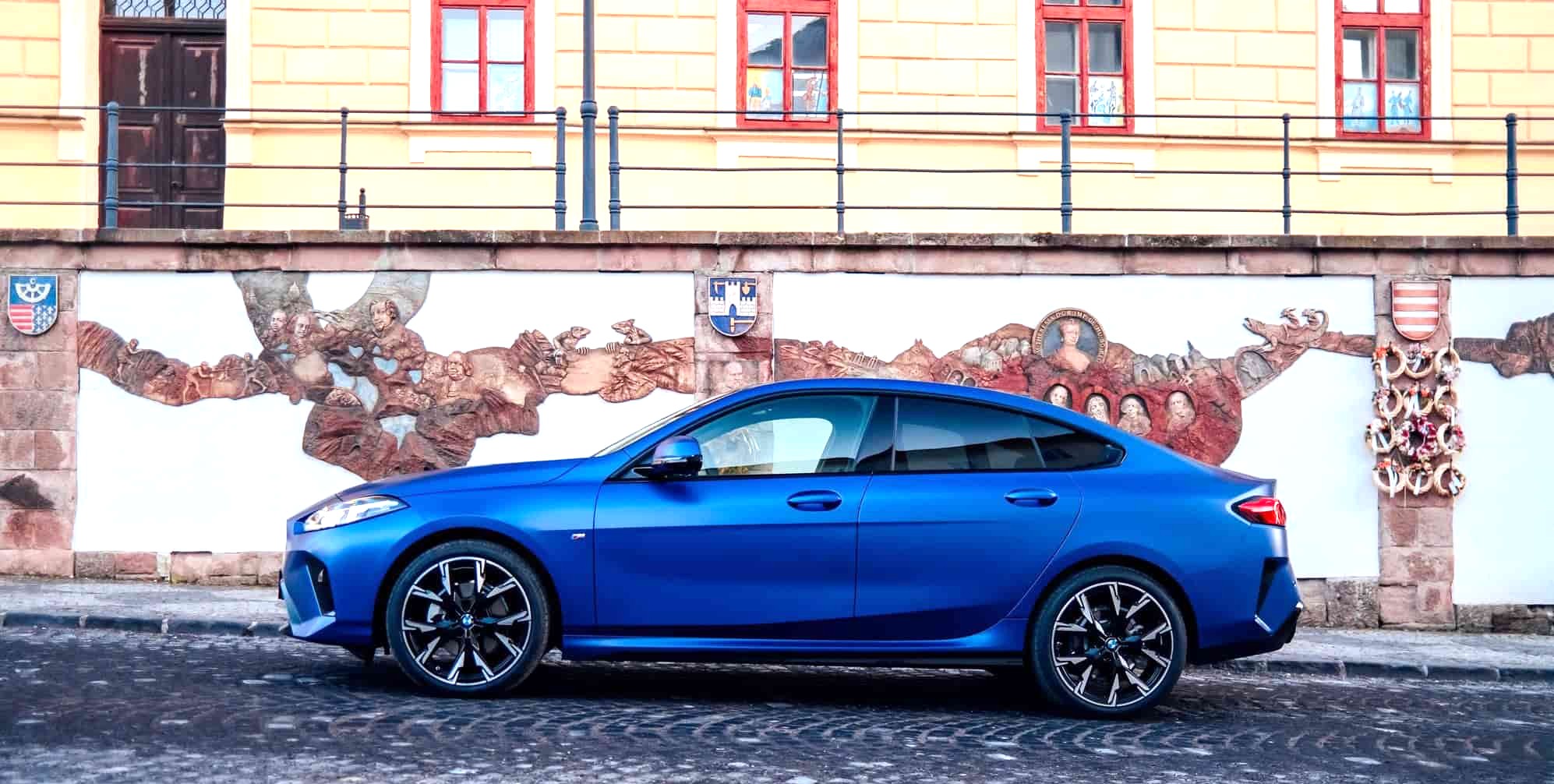
Maximum Towing capacity of the BMW 2 Series Gran Coupe F74. Need a F74 towbar?
The BMW 2 Series Gran Coupé F74 is one of the most misunderstood cars in BMW's current lineup. It wears a "2 Series" badge, carries the familiar kidney grille, and presents itself as a compact sports saloon with coupe-inspired styling. Yet beneath the surface, it is fundamentally different from the rear-wheel-drive-based BMW 2 Series Coupé. The F74, introduced for the 2025 model year as the second-generation 2 Series Gran Coupé, is built on BMW's front-wheel-drive architecture shared with the latest 1 Series. That fact alone has generated considerable debate among enthusiasts, but it also helps explain what this car is really trying to be.
Viewed objectively, the F74 is less a miniature 3 Series and more a premium compact four-door designed to compete directly with cars such as the Mercedes-Benz CLA and Audi A3 Sedan. In that role, it is a far stronger and more polished product than its predecessor.
From a design perspective, the F74 is cleaner and more mature than the first-generation F44. The proportions remain recognizably Gran Coupé, with a low roofline, frameless doors, a fastback silhouette, and a short rear deck. BMW has reduced some of the visual clutter that characterized the outgoing model. The nose is sharper, the lighting signatures are more sophisticated, and the overall appearance feels more cohesive. While it does not possess the classic long-hood rear-drive stance of a traditional BMW sports sedan, it looks premium and contemporary.
The dimensions have grown slightly, resulting in a car approximately 4.55 metres long, 1.80 metres wide, and riding on a 2.67-metre wheelbase. Despite its compact footprint, it has a substantial road presence, especially in M Sport trim.
Inside, the transformation is more significant. The cabin now feels far closer to BMW's larger and more expensive models. The centerpiece is the curved display housing a digital instrument cluster and central infotainment screen running BMW Operating System 9. The dashboard architecture is minimalist, with fewer physical buttons and a more technology-focused atmosphere. Materials have generally improved, and the fit and finish are among the strongest in the segment. Several reviewers have noted that the interior quality feels more substantial than some direct competitors despite the car's entry-level positioning.
The front seats deserve particular praise. BMW continues to excel at seat design, and even standard versions offer excellent support for long journeys. Driving position is low and sporty, visibility forward is good, and the cockpit wraps around the driver in a manner that still feels distinctly BMW.
Rear-seat accommodation is more complicated. The sloping roofline inevitably compromises headroom, and the rear doors are relatively small. Legroom is adequate for adults but not generous. BMW claims rear space approaches that of larger models, but in practice the cabin feels noticeably tighter than a 3 Series. Families with growing teenagers may find it somewhat restrictive on longer journeys.
The luggage compartment is respectable rather than class-leading. Depending on version, capacity ranges around 360 to 430 litres, making it suitable for everyday use, weekend trips, and airport runs without difficulty. Need to carry more stuff, or take your bikes along on the next weekend away? Consider fitting an Invisible towbar that will not ruin the designer looks of your new BMW.
Towing with the new BMW F74 Gran Coupe:
Towing is possible with the current BMW 2 Series Gran Coupé (F74), but it depends heavily on the engine variant, specifications and region (different tow rating depending on which country ☹ ).
BMW currently lists a braked trailer capacity of 1300 kg for some of the lower-output petrol models, with a maximum towball load of 75 kg.
In practical terms what this will allow:
- A small utility trailer: no problem.
- A lightweight camping trailer: generally fine if within the rated limits.
- A small boat trailer: often feasible, depending on total weight.
- A large caravan or heavy boat: the F74 is not the ideal tool.
According to gross mass, the vehicle’s structure can accommodate up to 2000 kg – our towbar is rated to this limit – for now, BMW has given the F74 a lower limit, check your owner’s manual or contact your dealer to check your vehicles max. Remember, you cannot tow more than your specific BMW is rated for, irrespective of the towbar fitted.
The car's front-wheel-drive-based platform is stable and refined, but it is not engineered as a heavy-duty tow vehicle. The relatively short wheelbase and modest vehicle mass mean that once trailer weights approach the legal maximum, you'll notice more sensitivity to crosswinds and trailer movement than you would in a larger BMW such as a BMW 3 Series Touring, BMW 5 Series Touring, or BMW X3.
For the performance-oriented M235 xDrive, towing capacity can differ by market and homologation. BMW sometimes reduces or omits towing approval on high-performance variants, so the exact VIN or local specification should be checked before assuming the same limits apply.
One thing I would particularly watch with the F74 is transmission heat during prolonged towing. The 7-speed dual-clutch gearbox is excellent for normal driving, but unlike BMW's larger ZF torque-converter automatics, it isn't primarily designed around frequent heavy towing.
Thinking of a towbar, ensure it is an Euro style Invisible model, to keep your Gran Coupe looking the way BMW designers intended.
Back to reviewing the Gran Coupe, mechanically, the F74 reflects BMW's broader shift toward electrified four-cylinder powertrains. The range starts with modest petrol engines producing around 122 hp and 156 hp, progresses through stronger variants, and culminates in the M235 xDrive with 312 hp. Depending on market, mild-hybrid technology is integrated into several engines to improve efficiency and responsiveness. Power is delivered through a seven-speed dual-clutch transmission across the lineup.
The mainstream engines are likely to be the sweet spot for most buyers. The 218 and 220 variants offer sufficient performance for daily driving while maintaining excellent fuel economy. The dual-clutch transmission shifts quickly and smoothly in most conditions, though it can occasionally feel less polished than BMW's traditional ZF torque-converter automatics found in larger models.
The headline performer is the M235 xDrive. With 312 hp and all-wheel drive, acceleration is genuinely rapid, reaching 60 mph in well under five seconds. Straight-line performance is not merely adequate; it is legitimately fast. The engine pulls strongly through the mid-range and the all-wheel-drive system provides impressive traction in poor weather conditions.
The biggest question surrounding the F74 concerns handling. Traditional BMW enthusiasts often criticize the front-wheel-drive platform because it lacks the balance and purity of the company's classic rear-wheel-drive cars. There is some truth to this criticism. The F74 does not steer with the delicacy of a 3 Series, nor does it rotate through corners with the natural poise of a rear-driven BMW.
However, context matters. Compared with most compact premium rivals, the F74 remains one of the more engaging cars in its class. Steering is precise, body control is strong, and grip levels are high. The chassis feels composed and confidence-inspiring on twisting roads. It simply delivers its performance differently than older BMWs.
The standard models strike a particularly appealing balance between comfort and handling. They are stable at motorway speeds, quiet enough for long-distance travel, and agile in urban environments. The suspension absorbs everyday imperfections reasonably well while maintaining good body discipline.
The M235 introduces a different character. Its suspension tuning is considerably firmer, and many reviewers have found the ride harsh on rough roads. While the additional power and sharper responses are appealing, the trade-off in everyday comfort is noticeable. For drivers spending significant time on imperfect roads, the regular 220 or 228 versions may actually be more satisfying overall.
Technology is one of the F74's strongest areas. BMW's latest infotainment system is fast, visually attractive, and highly configurable. Wireless Apple CarPlay and Android Auto are standard, voice recognition is effective, and the digital displays are among the best in the segment. Features such as wireless charging, premium audio systems, connected services, and advanced driver-assistance systems make the car feel thoroughly modern.
Safety equipment is comprehensive. BMW includes a broad suite of driver-assistance technologies, including collision warning systems, lane-keeping aids, and adaptive cruise functionality depending on specification. The car feels designed around modern expectations rather than merely meeting regulatory requirements.
Ownership considerations are generally positive. The modern powertrains are efficient, build quality appears solid, and BMW's dealer network remains extensive. However, as with most premium German cars, maintenance and repair costs will exceed those of mainstream alternatives. Depreciation should be considered carefully, particularly on heavily optioned examples.
The enthusiast community remains divided. Some BMW traditionalists dislike the front-wheel-drive origins and argue that the car lacks the brand's historical character. Others acknowledge that it succeeds well as a compact premium sports saloon and appreciate the improved interior, technology, and everyday usability. The debate is less about whether the car is good and more about whether it is "BMW enough."
In the final analysis, the F74 is not a miniature 3 Series and it is certainly not a four-door version of the rear-wheel-drive 2 Series Coupé. Buyers expecting either of those things may be disappointed. But judged on its own merits, it is a sophisticated, stylish, technologically advanced compact premium sedan that performs its intended role exceptionally well. The interior is excellent, the technology is class-leading, the engines are strong, and the overall refinement is significantly improved over the previous generation.
Its weaknesses are relatively clear: rear-seat space is limited, the M235 can ride too firmly, and the front-wheel-drive platform lacks the dynamic magic associated with BMW's best sports sedans. Yet for many buyers seeking a compact luxury car with strong performance, premium ambience, and distinctive styling, the BMW 2 Series Gran Coupé F74 is arguably the most complete version of this concept that BMW has produced so far. It may not be a purist's BMW, but it is a very good modern BMW.
Need to increase the practicality of your BMW 2 Series Gran Coupe – why not fit one of our F74 2 Series towbars - order today.


 The tow bar becomes completely invisible - the lines of your car are not spoiled in the slightest.

 Select your Vehicle


