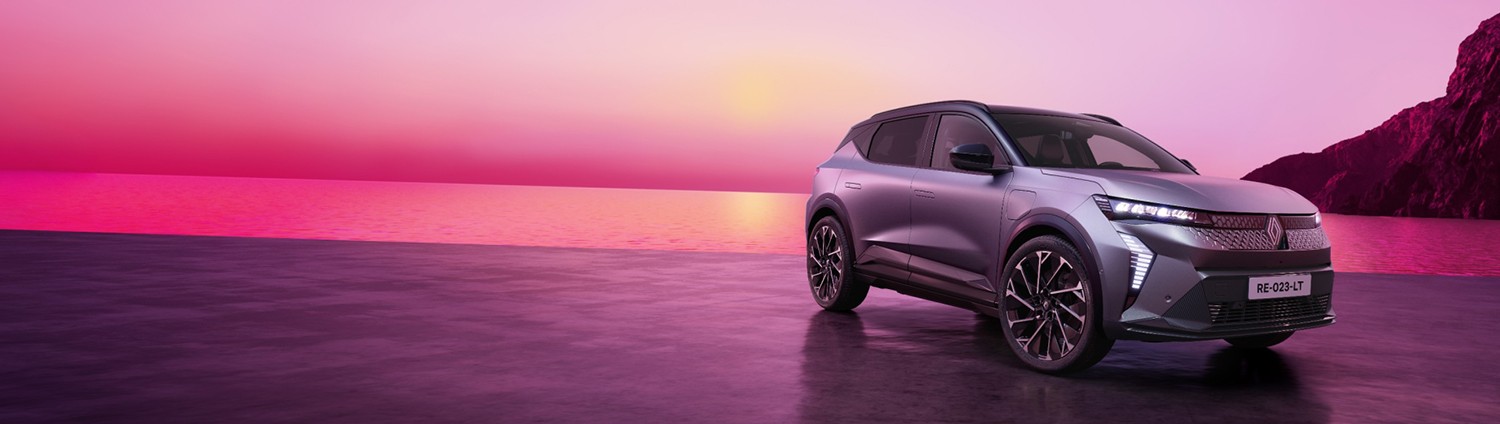
Renault Scenic E-Tech — can it tow? Maximum towing capacity – need a Scenic E-Tech towbar?
The Scenic E-Tech is interesting because it doesn’t feel like a car designed by a marketing department chasing trends. It feels like Renault asked a simpler question:
“What would make an electric family car genuinely pleasant to live with every day?”
That mindset shapes almost every part of the vehicle.
The Scenic is not the fastest EV, not the most futuristic, not the most luxurious, and not the longest-range car in the segment. Yet after long-term tests and owner experiences, it repeatedly emerges as one of the most satisfying all-round family EVs in Europe.
What the Scenic actually is:
Despite the badge, this is no longer a traditional MPV.
The original Scenic was upright, airy, modular, and almost van-like in practicality. The new E-Tech version is closer to a compact crossover with hatchback proportions. Renault clearly wanted something emotionally appealing rather than purely functional.
But unlike many “SUV-styled” EVs, it still retains some MPV DNA:
- excellent packaging
- strong passenger space
- intelligent cabin layout
- easy day-to-day usability
The result is a car that feels smaller than it is from outside, yet larger than expected once inside.
That balance is rare.
Exterior design — understated but intelligent
The Scenic doesn’t try too hard visually.
Many modern EVs lean into exaggerated futurism:
- enormous wheels
- aggressive lighting signatures
- awkward aerodynamic experiments
- overstyled surfaces
The Scenic avoids most of that.
Its design works because it looks cohesive. The nose is clean, the proportions are balanced, and the body sides avoid unnecessary drama. The surfacing is modern but restrained.
You notice another important thing after a few days: it does not feel intimidating in urban environments.
That matters more than people admit.
A Tesla Model Y, Kia EV9, or even a Skoda Enyaq can feel bulky the Scenic is easier to place on narrow roads and in tight parking structures.
The downside is visibility.
The sleek roofline and thick pillars create a more enclosed feeling than older Renault family cars. Several owners and reviewers specifically criticize rear visibility and the relatively narrow glass area.
So while the exterior looks elegant, it sacrifices some of the panoramic openness people associate with classic MPVs.
The interior — where Renault got most things right
This is the car’s strongest area.
The Scenic interior feels like it was designed by people who actually use cars daily rather than by interface designers chasing minimalism.
Space
The cabin packaging is excellent.
Rear legroom is genuinely impressive for the footprint. Even tall adults fit comfortably behind tall drivers. Multiple reviewers mention how unusually spacious the rear seats feel.
What makes the cabin feel successful is not just dimensions, but proportions:
- the floor is flat
- knees are naturally positioned
- the seating angle is comfortable
- ingress and egress are easy
There is also a calmness to the interior layout.
You do not feel overwhelmed by giant glossy surfaces or gimmicky architecture. The dashboard has shape and texture without becoming visually noisy.
Material quality and atmosphere
The Scenic does not feel premium in the German luxury sense.
Instead, it feels thoughtfully assembled.
Renault uses:
- textured fabrics
- recycled materials
- soft-touch upper surfaces
- matte finishes
- restrained ambient lighting
The atmosphere is modern and warm rather than aggressively technological.
Some lower plastics are still hard, and if you look closely you can tell this is a mainstream car, not a luxury one. But reviewers consistently note that the interior quality exceeds expectations for the price point.
One particularly successful detail is the absence of excessive piano black trim. The cabin ages visually better because of it.
Ergonomics — Renault learned from industry mistakes
This may be the most important reason many owners end up loving the Scenic.
Renault resisted the temptation to make everything touchscreen-only.
That sounds minor until you actually live with modern EVs.
The Scenic still gives you:
- physical steering-wheel controls
- sensible climate access
- intuitive menus
- straightforward drive-mode selection
- predictable interface logic
Several long-term reviewers specifically praise the usability advantage compared with more touch-dependent rivals.
This dramatically reduces cognitive fatigue on long drives.
You spend less time managing the car and more time simply driving it.
Infotainment — one of the best systems in the class
The Google-based OpenR infotainment system is genuinely excellent.
Unlike many legacy automaker systems, it feels modern:
- quick responses
- clear graphics
- strong navigation logic
- excellent route planning
- good voice recognition
Google Maps integration is especially valuable in an EV because charging planning becomes almost frictionless.
The system automatically:
- estimates battery arrival percentage
- plans charging stops
- preconditions the battery
- adapts routing dynamically
That creates a feeling of confidence during long-distance travel.
Owners repeatedly mention that the software feels more polished and stable than Volkswagen’s earlier EV systems.
However, it is not flawless.
Some owners report:
- occasional freezes
- buggy navigation behavior
- unreliable phone connectivity
- intermittent app problems
Still, relative to the industry average, Renault’s software execution is surprisingly mature.
Driving experience — calm rather than exciting
The Scenic’s personality becomes clear within minutes:
it prioritizes ease.
The steering is light and quick.
The throttle response is smooth.
Noise suppression is excellent.
The suspension aims for comfort first.
This is not a sporty EV pretending to be a family car.
Instead, it feels optimized for reducing stress.
That distinction matters enormously over thousands of kilometers.
Ride comfort
The Scenic rides well, though not perfectly.
At moderate speeds it feels refined and composed, with a softness many competitors lack. Long motorway journeys are especially relaxing because:
- wind noise is low
- drivetrain noise is almost absent
- seats are supportive
- suspension settles nicely at cruising speeds
This is where the car feels genuinely expensive.
But there is a caveat.
On larger wheels, sharp impacts can feel abrupt. Multiple reviewers mention that potholes and broken surfaces occasionally create a thumpy or sudden reaction from the suspension.
So the car is comfortable overall, but not floaty in the classic French-car sense.
Steering and handling
The steering is unusually quick for a family crossover.
Initially this can feel nervous or artificial, especially at motorway speeds. But after adaptation, many drivers appreciate the agility it gives the car.
The Scenic changes direction more eagerly than expected.
It feels lighter than many EVs because:
- body control is decent
- weight transfer is managed well
- the front end responds quickly
You never forget the battery mass, but Renault has done a good job disguising it.
Still:
- it is front-wheel drive
- not performance-oriented
- not especially emotional
Acceleration is brisk enough to feel modern, but it does not deliver the dramatic surge associated with Tesla or Hyundai/Kia dual-motor EVs.
Long-distance driving — the Scenic’s true purpose
This is where the car becomes genuinely impressive.
The Scenic excels at sustained, real-world travel.
Many EVs feel optimized around:
- acceleration figures
- charging headlines
- screen size
- novelty
The Scenic instead focuses on fatigue reduction.
After several hours behind the wheel, drivers consistently report feeling relaxed rather than overstimulated.
That comes from many small decisions:
- low cabin noise
- comfortable seating
- smooth power delivery
- intuitive controls
- stable motorway behavior
- excellent navigation integration
It feels engineered for actual European road trips.
Range — very good, but not miraculous
The official WLTP numbers are ambitious.
Real-world results are more nuanced.
The long-range 87 kWh version typically delivers:
- roughly 430–540 km in mixed real-world use
- around 450–500 km in favorable weather
- noticeably less during winter motorway driving
Efficiency is good but speed-sensitive.
At high motorway speeds, range drops significantly, as owners repeatedly note.
Winter performance is a recurring criticism. Several long-term testers observed a substantial cold-weather efficiency penalty.
Still, the car compensates through usability.
Because the route planning is strong and the battery is relatively large, the Scenic often feels less stressful than EVs with technically better charging specs.
Charging — adequate, not exceptional
This is probably the car’s clearest weakness.
The Scenic charges at up to 150 kW DC.
That is perfectly usable, but no longer impressive in 2026.
Compared with Hyundai/Kia’s 800V platforms:
- charging sessions are longer
- peak speeds are lower
- repeated motorway charging is less efficient
For occasional long-distance travel this is fine.
For drivers regularly covering huge motorway distances, competitors may feel noticeably quicker.
Still, Renault’s battery management and charging curve appear reasonably well tuned. Owners generally describe the charging experience as dependable rather than frustrating.
Reliability and ownership concerns
Overall ownership feedback is positive.
The Scenic does not appear plagued by catastrophic faults, but there are recurring smaller complaints:
- infotainment glitches
- sensor sensitivity in rain
- occasional trim issues
- inconsistent app behavior
- mediocre camera quality
The brake pedal also receives frequent criticism.
Many reviewers describe it as:
- grabby
- artificial
- difficult to modulate smoothly
That is one area where the EV calibration still feels unfinished.
What the Scenic feels like emotionally
This is the hardest thing to quantify, but perhaps the most important.
The Scenic feels humane.
That may sound vague, but after years of increasingly aggressive automotive design, it stands out.
It does not constantly demand attention.
It does not try to impress you every five seconds.
It does not turn every interaction into a software experiment.
Instead, it quietly removes friction from daily life.
That is probably why long-term reviewers become unexpectedly attached to it.
Who should buy it?
The Scenic E-Tech makes the most sense for someone who values:
- comfort over performance
- usability over gimmicks
- space efficiency over sheer size
- thoughtful software over giant screens
- relaxed travel over sporty driving
It is especially strong for:
- families
- commuters
- mixed urban/motorway use
- European road-trip driving
Who may be disappointed?
Drivers seeking:
- maximum charging speed
- sports-sedan dynamics
- luxury-car isolation
- huge towing capability
- dramatic styling
- true MPV practicality
may find rivals more suitable.
Official towing figures
For most versions of the Scenic E-Tech:
- Braked towing capacity: up to 1400 kg - check your owners manual
- Unbraked towing capacity: 750 kg
- Permissible nose weight: 75 kg
That places it roughly in the middle of the EV market.
It is enough for:
- small caravans
- utility trailers
- lightweight camping trailers
- small boats
- motorcycles
- bicycles on towbar carriers
But it is not ideal for:
- large twin-axle caravans
- horse trailers
- heavy enclosed cargo trailers
- large boats
Compared with diesel family SUVs, the towing capacity is modest.
What the Scenic feels like while towing
Low-speed towing is effortless
Like most EVs, the Scenic is extremely good at pulling away smoothly.
Electric torque makes:
- reversing easier
- hill starts calmer
- maneuvering trailers more precise
There is none of the clutch slipping or turbo lag you get in combustion vehicles.
For:
- campsite maneuvering
- urban towing
- trailer parking
the Scenic actually feels very competent.
Stability and chassis behavior
The car’s chassis is reasonably stable while towing, helped by:
- low battery-mounted center of gravity
- substantial kerb weight
- quick steering
- good wheelbase stability
However, you can still tell Renault tuned the suspension for comfort rather than heavy hauling.
With a trailer attached:
- the rear suspension settles noticeably
- sharp bumps feel heavier
- body control becomes softer
It never feels dangerously unstable within limits, but it also does not feel “built for towing” in the way a large diesel SUV does.
The 75 kg nose-weight limit is especially important.
Many caravans can exceed this surprisingly easily once loaded.
Range impact — this is the real issue
This is where towing with the Scenic becomes complicated.
The car itself has enough torque to tow comfortably.
The problem is aerodynamic drag.
Several EV owners across Reddit discussions repeatedly mention that towing dramatically reduces EV range, especially with caravans.
And the Scenic is already:
- not especially aerodynamic at motorway speeds
- relatively tall for an EV
- less efficient than Tesla at high-speed cruising
So when you add a caravan, efficiency drops sharply.
Realistic towing range expectations
Small utility trailer
Minimal impact.
You may lose:
This is the Scenic’s sweet spot.
Small camping trailer
Moderate impact.
Expect:
Still practical for regional travel.
Charging while towing — often worse than the towing itself
This is the hidden problem most reviews barely mention.
Public charging infrastructure is still poorly designed for trailers.
Owners frequently report needing to:
- unhitch caravans before charging
- occupy multiple spaces awkwardly
- maneuver carefully in tight charging stations
For long-distance caravan touring, this becomes tiring quickly.
The Scenic’s decent-but-not-exceptional 150 kW charging also means stops are not especially short.
So towing long distance in the Scenic is absolutely possible —
but requires patience and planning.
Thermal management and mountain towing
One area where EVs often outperform combustion cars is climbing.
The Scenic handles hills smoothly because:
- torque delivery is immediate
- there are no gear changes
- regenerative braking helps downhill control
For moderate trailer weights, mountain driving can actually feel easier than in small petrol SUVs.
However:
- sustained high-speed towing uphill will increase consumption massively
- charging frequency rises quickly
The car remains capable, but efficiency collapses under heavy aerodynamic load.
Braking and regen behavior
The Scenic’s regenerative braking helps significantly while towing lighter loads.
Benefits include:
- smoother downhill speed control
- reduced brake wear
- calmer urban driving
But Renault’s brake pedal calibration already feels somewhat artificial in solo driving, and towing can amplify that sensation.
The transition between:
- regen braking
- friction braking
can feel inconsistent at low speeds.
It is manageable, but not as polished as the best EV towing systems.
Is it good for caravans?
Occasional caravan use?
Yes.
Especially for:
- lightweight caravans
- weekend trips
- regional camping
- moderate distances
The Scenic is entirely usable.
Frequent long-distance caravan touring?
Less convincing.
You will encounter:
- major range loss
- frequent charging stops
- charging-station inconvenience
- slower travel pace
For heavy caravan users, vehicles with:
- larger batteries
- higher towing limits
- better motorway efficiency
- faster charging
are usually more suitable.
What the Scenic tows best
The Scenic makes the most sense with:
- bike carriers
- small utility trailers
- lightweight camping trailers
- compact boats
- garden trailers
- DIY/home-improvement hauling
That aligns with the vehicle’s overall personality:
practical family utility rather than industrial hauling.
The Scenic is competitive for light towing, but not class-leading.
The overall truth about towing with the Scenic
The Scenic E-Tech is best understood as:
“a comfortable family EV that happens to tow reasonably well.”
Not:
“a dedicated towing vehicle.”
Within realistic expectations, it performs competently:
- stable
- smooth
- easy to maneuver
- pleasant at lower speeds
But once towing becomes a major lifestyle use case — especially motorway caravanning — its limitations become obvious:
- moderate tow rating
- substantial range loss
- average DC charging speed
- charging infrastructure frustrations
For occasional towing, it is genuinely good.
For serious caravan life, there are better EV choices — and in some cases, diesel still remains easier.
Final judgment
The Scenic E-Tech is not revolutionary.
Its brilliance comes from restraint.
Renault identified the things that actually matter after six months of ownership:
- comfort
- ergonomics
- cabin usability
- low fatigue
- packaging efficiency
- software integration
And then executed those things unusually well.
The result is one of the most coherent family EVs currently available.
Not the most exciting.
Not the most advanced.
But arguably one of the easiest to genuinely live with every day.
Want to increase the practicality of your Scenic E-Tech, be sure to fit one of our Renault towbars today!


 The tow bar becomes completely invisible - the lines of your car are not spoiled in the slightest.

 Select your Vehicle


