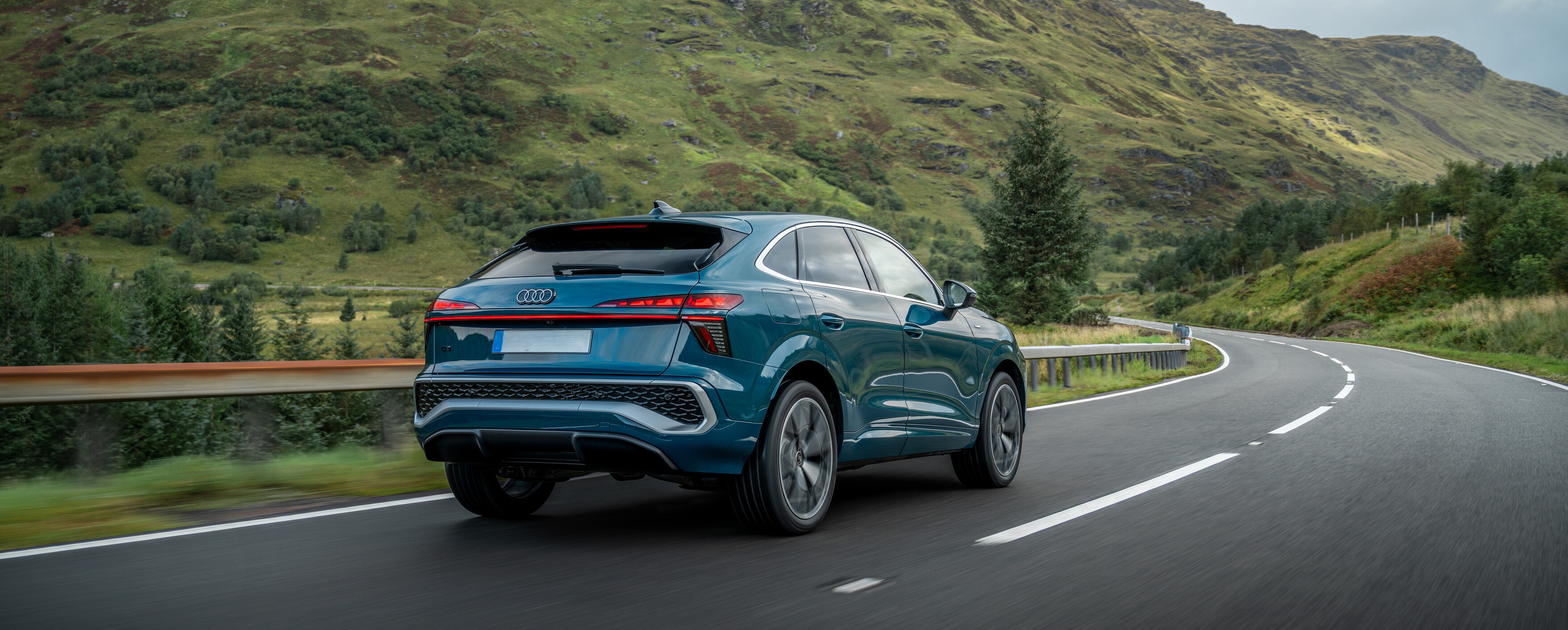
Towing review of the new 3rd Gen Audi Q3. Maximum allowed trailer weight – need an Audi Q3 towbar – we have you covered
The newest 3rd generation of the Audi Q3 represents a careful but substantial evolution of Audi’s compact luxury SUV philosophy. Rather than radically reinventing the formula that made the previous Q3 successful, Audi focused on refining almost every element—structure, powertrain, technology, and driving character—so that the vehicle feels noticeably more mature, more refined, and more technologically integrated than its predecessor. The result is a car that sits comfortably between the compact practicality expected of the segment and the polished driving experience associated with larger Audi models.
At the structural level, the FJ-chassis Q3 continues to rely on the Volkswagen Group’s transverse-engine architecture, a development of the MQB platform that underpins many vehicles across the group. In this iteration the structure has been reinforced and optimized for greater rigidity and better compatibility with electrified powertrains. The body shell benefits from improved bonding techniques and strategically placed high-strength steels, which increase torsional stiffness without significantly increasing weight. Greater structural rigidity allows the suspension to operate more precisely, which in turn improves ride quality and handling consistency. The overall footprint of the vehicle has grown slightly compared with the previous generation, giving the Q3 a more planted stance and allowing designers to extract additional interior space without making the car feel bulky in urban environments.
From the outside, the design communicates a shift toward Audi’s more modern aesthetic language. The front fascia is dominated by a wide single-frame grille that appears lower and broader than before, flanked by sharply defined LED headlamps. The lighting signatures are particularly intricate, using segmented daytime running lights that create a distinctive visual identity at night. The surfaces of the body are sculpted with angular creases that run along the shoulder line and over the wheel arches, emphasizing width and stability. While the proportions remain recognizably Q3, the visual mass has been redistributed in a way that makes the vehicle appear both more athletic and more sophisticated. The roofline gently tapers toward the rear, especially in the Sportback variant, giving the SUV a subtle coupe-like profile without sacrificing too much practicality.
Underneath that exterior lies a suspension configuration that is familiar yet finely tuned. At the front the car uses a MacPherson strut arrangement, a compact and cost-effective design that works well for vehicles with transverse engines. At the rear there is a multi-link suspension system, which provides greater control over wheel movement and allows engineers to tune ride comfort and handling characteristics more precisely. Audi’s calibration prioritizes stability and refinement rather than aggressive sportiness. The vehicle feels composed and controlled at highway speeds, with suspension damping that absorbs road imperfections effectively while still maintaining body control through sweeping corners. Optional adaptive dampers allow drivers to alter the character of the ride through selectable driving modes, shifting from a soft, comfort-oriented setup to a firmer and more responsive configuration.
Steering is electrically assisted and tuned to be light and easy at low speeds while remaining stable on the highway. The progressive steering option adjusts the ratio depending on steering input, making tight maneuvers in urban environments easier while preserving stability during fast driving. Although the steering does not deliver the intense feedback of a sports car, it feels accurate and predictable, reinforcing the Q3’s overall sense of security and approachability.
The powertrain lineup demonstrates Audi’s transition toward electrification while maintaining traditional internal combustion options. Entry-level engines include efficient turbocharged four-cylinder units paired with mild-hybrid systems that use a 48-volt electrical architecture. These mild-hybrid systems recover energy during braking and assist the engine during acceleration, reducing fuel consumption while improving throttle response. Higher-output variants rely on larger turbocharged engines capable of delivering strong acceleration and confident highway performance. The most notable addition to the range is the plug-in hybrid variant, which pairs a turbocharged gasoline engine with a substantial electric motor and battery pack. This configuration allows the Q3 to travel significant distances on electric power alone, transforming the vehicle into an efficient commuter for urban driving while still providing the flexibility of a combustion engine for longer trips.
For versions equipped with all-wheel drive, Audi employs its electronically controlled Quattro system designed for transverse engine platforms. Unlike the permanent mechanical systems used in some larger Audi models, this system normally sends power to the front wheels and engages the rear axle only when additional traction is required. The coupling can react quickly to wheel slip or aggressive throttle input, directing torque to the rear wheels when necessary. While it may not provide the same rear-biased driving dynamics as some performance-oriented all-wheel-drive systems, it offers excellent traction in poor weather and maintains good fuel efficiency during everyday driving.
Inside the cabin, the Q3 has evolved to resemble a scaled-down version of Audi’s larger SUVs. The dashboard architecture is dominated by digital displays and sharp geometric surfaces that wrap slightly around the driver. Audi’s digital instrument cluster replaces traditional gauges with a customizable screen capable of displaying navigation maps, driving data, and vehicle information in multiple layouts. The central infotainment display integrates navigation, connectivity, and vehicle controls, and it supports wireless smartphone integration as well as over-the-air software updates.
Material quality is generally high, though not quite at the level of Audi’s larger luxury models. Soft-touch surfaces cover most areas within reach, while aluminum trim and subtle ambient lighting enhance the sense of sophistication. The seats are supportive and ergonomically shaped, making the Q3 comfortable for long journeys. Rear passengers benefit from a sliding rear bench that allows occupants to trade legroom for cargo capacity depending on their needs. This flexibility contributes to the vehicle’s practicality, giving it an advantage over some competitors whose rear seating arrangements are fixed.
One of the most impressive improvements in the new generation is the attention given to noise reduction and overall refinement. Engineers have added thicker acoustic glass in the front side windows and improved insulation around the firewall and wheel arches. As a result, road and wind noise are noticeably subdued at highway speeds. The cabin environment feels calmer and more isolated from the outside world, giving the Q3 a level of quietness that approaches that of larger premium SUVs.
Driving the Q3 reveals a vehicle that is deliberately balanced. It is not designed to be the most aggressive or thrilling car in its class; instead, it aims to provide a harmonious combination of comfort, efficiency, and everyday usability. Acceleration from the more powerful engines is brisk, and the dual-clutch transmission shifts quickly and smoothly, delivering a responsive driving experience without sacrificing efficiency. The brakes feel strong and progressive, inspiring confidence during sudden stops or spirited driving.
Within the competitive landscape of premium compact SUVs, the Q3 occupies an interesting position. Vehicles like the BMW X1 often emphasize sportiness, while models such as the Mercedes‑Benz GLA lean toward style and comfort. The Q3 finds a middle ground between these approaches, offering a balanced driving experience combined with strong technology integration and a highly practical interior layout.
Considering towing with the newest Audi Q3 you must remember that the 3rd gen Q3 is a compact crossover rather than a heavy-duty utility vehicle. The Q3 is engineered primarily for daily driving comfort, efficiency, and urban practicality, yet Audi still designed it with enough structural strength and drivetrain capability to handle light trailers and recreational equipment.
In most global configurations of the new Q3, the maximum braked towing capacity reaches 2,100 kg for 2.0-litre quattro models. Lower-powered front-wheel drive and mild hybrid variants have a reduced capacity, generally around 1,700kg–1,800kg, with the e-hybrid rated at a max of 1,400 kg. If the trailer does not have its own brakes, the allowable weight is typically limited to around 750 kg.
These figures place the Q3 near the upper end of towing ability for compact luxury crossovers. In some specifications, however, the rating can be lower – check your owner’s manual.
The MQB-based platform uses a relatively rigid unibody structure with reinforced mounting points for the towbar assembly. This allows towing loads to be distributed through the rear subframe and body shell without overstressing any single component. The suspension maintains stability when carrying additional vertical load on the towbar.
In real-world terms, the towing capability of the Q3 is best suited to lighter recreational loads rather than heavy caravans or large boats. Owners typically use vehicles in this class to pull small camping trailers, jet skis, compact utility trailers, or bike carriers. Audi recommends maintaining a modest tongue weight and ensuring the trailer is equipped with brakes if approaching the higher end of the towing rating.
The experience of towing with the Q3 tends to feel stable and controlled for modest loads, but the relatively short wheelbase and compact mass of the vehicle mean that it does not have the planted feel of larger SUVs designed primarily for towing. Compared with something like a midsize SUV, the Q3 will be more sensitive to crosswinds and trailer sway when pulling heavier trailers. Keeping loads well below the maximum rating generally results in the most comfortable and predictable behavior.
Overall, the third-generation Q3 functions as a capable light-duty tow vehicle when equipped with our Invisible Euro Towbar, but its design priorities remain focused on everyday usability, efficiency, and premium driving refinement. It works best for occasional recreational towing rather than routine hauling of large or heavy trailers.
Ultimately, the FJ-generation Audi Q3 feels like a vehicle that has matured alongside its audience. It retains the approachable size and versatility that made the original Q3 appealing, but it layers those qualities with a more sophisticated design, improved ride refinement, and a forward-looking powertrain lineup that includes meaningful electrification. The result is a compact luxury SUV that may not dominate every category outright, but excels in delivering a cohesive and well-rounded ownership experience.
Want to increase the practicality and functionality of your Audi Q3, order our Invisible 23rd generation towbar today – fits both the SUV and Sportback.


 The tow bar becomes completely invisible - the lines of your car are not spoiled in the slightest.

 Select your Vehicle


