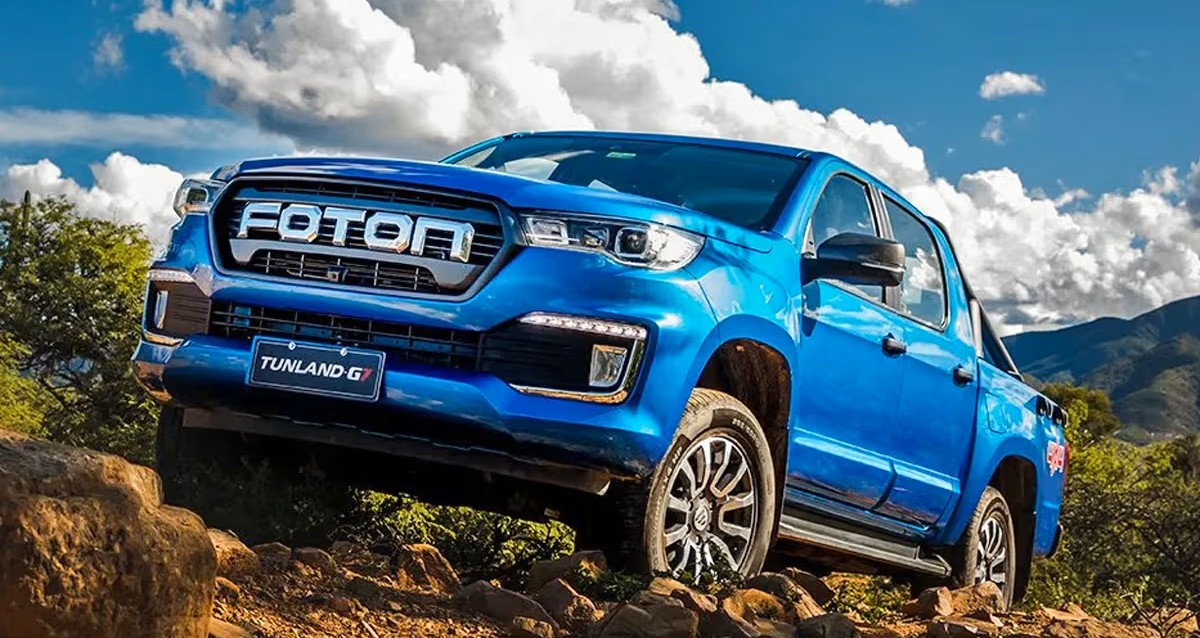
Towing review of the new Foton Tunland G7. Need a Foton Tunland G7 towbar?
The Foton Tunland G7 marks Foton’s latest bid to deliver a competitive pickup in a global market crowded with well-established rivals. Its presence in Europe, Australia, and Asia signals Foton’s intention to give buyers a compelling package that blends capability, equipment and value, especially in the double-cab 4×4 segment. As a successor to previous Tunland models, the G7 refines and modernises many aspects, although the broader challenge remains convincing buyers that a Chinese-brand ute can match the durability and brand trust of older Japanese models.
From first glance, the Tunland G7 carries a bold and muscular presence befitting a modern pickup. Its dimensions — just over 5.34 metres long, nearly two metres wide and with a generous 3.11-metre wheelbase — give it substantial road presence and a stable foundation both on highway journeys and off-road excursions. The body has a purposeful stance, with wide flared guards and a front end that avoids overly aggressive styling in favour of robust proportions that hint at capability. The large cargo tray, with internal dimensions around 1.52 by 1.58 metres, is practical for work or adventure gear, and the availability of accessories such as trays, roll bars and optional hooks reinforces its utilitarian DNA.
Under the bonnet, Tunland G7 consistently uses a 2.0-litre four-cylinder turbodiesel engine developed in collaboration with respected engineering partners including Ricardo and supported by Bosch common-rail injection technology. This power unit produces around 120 kW and 390 Nm of torque, which positions it well in terms of torque for towing, load hauling and off-road traction, although refinement falls short of the quietness and smoothness found in some competitor diesels. The engine can be paired with a 6-speed manual or an 8-speed automatic ZF gearbox, the latter being the more refined and smoother choice for everyday use.
The drivetrain includes a BorgWarner electronic part-time 4WD system with selectable modes for two-wheel drive (2H), automatic torque distribution, high-range 4WD and low-range 4WD, giving the G7 genuine capability in slippery or rugged terrain. The presence of a low-range transfer case and rear differential lock on higher-spec variants means the Tunland G7 can be a credible off-road tool for farmers, tradies and weekend explorers alike.
Inside the cabin, Foton has clearly tried to elevate the experience beyond the bare-bones utilitarian feel often associated with work trucks. Most markets receive a dual digital display setup, with one large 12.3-inch screen for infotainment and another for the digital instrument cluster, giving the cockpit a contemporary look and feel. Higher specification models include leatherette or premium cloth seats with heating, ventilation and power adjustment, dual-zone climate control, ambient lighting and a suite of storage compartments that enhance usability. Connectivity is generous, with Android Auto and Apple CarPlay, multiple USB ports including rear-seat ports, and a mix of physical controls alongside the touchscreen to balance ease of use with modern technology.
In terms of technology and safety, the Tunland G7 is well equipped for its class. The safety suite varies by market and trim, but is often anchored by stability control, anti-lock braking with electronic brakeforce distribution, multiple airbags, tyre pressure monitoring and electronic driver aids such as hill start and descent control. More advanced features on higher grades include a 360-degree camera system, blind-spot detection, lane change assist and forward collision warning, which bring a level of safety and convenience rarely seen as standard in budget pickups.
On the road, impressions from early testers and reviews reflect a mixed picture. The Tunland G7’s powertrain offers strong torque and respectable performance for a biennial pickup, allowing it to keep pace with everyday driving and loaded highway work. The engine’s character, however, leans toward a gruff, diesel note with noticeable turbo lag, especially at low engine speeds, and refinement is not up to the polished levels seen in premium rival utes. Manual gearboxes have been criticised for short, notchy ratios and a sensitive clutch, while the 8-speed automatic generally delivers smoother performance and greater appeal for daily driving. Ride quality is firm, particularly unladen, which is typical of pickups with leaf-spring rear suspension, but the high ground clearance and 4×4 capability are definite assets when the terrain gets rough.
Work capability is one of the Tunland G7’s most convincing traits. With a gross vehicle mass near 2980 kg and payload figures close to 955 kg in many markets, it competes well against similarly sized pickups when it comes to carrying gear or tools. Towing capacity is up to 3000-3500 kg, a figure that puts it on par with mainstream dual-cab competitors, and makes the G7 a capable tow vehicle for caravans, trailers and boats around that threshold.
Strengths of the Tunland G7 include its comprehensive equipment levels for the price point, modern cabin design, capable 4×4 system and strong torque from the diesel engine. Its competitive pricing relative to established rivals has been noted positively in many markets, where reviewers observed that the G7 offers more features than many similar pickups at similar prices. Warranty offerings, add confidence and address a common hesitation with newer brands.
Nevertheless, there are areas where the Tunland G7 shows its origins in cost-sensitive engineering. Build quality impressions from early testers point to some harder plastics and fit-and-finish inconsistencies, and engine refinement lags behind some peers. Ride comfort without load can be bouncy, a trait shared with many pickups but accentuated here due to firm suspension tuning and the heavy front-engine balance. Brand perception and resale value remain open questions in many Western markets, where Chinese-brand utes are relatively new and buyer confidence takes time to build. Insights from owners of older Foton models suggest parts and service network depth can vary considerably, becoming a practical concern in markets without strong dealer support.
When it comes to towing, the Foton Tunland G7 sits right in the heart of what most buyers expect from a modern double-cab diesel ute. The G7 is rated to tow up to 3500 kg (region and spec dependant) with a braked trailer. Whether you’re looking to tow a caravan, a boat, a horse float or a loaded trailer, that three-tonne rating places it on a similar footing to many mainstream rivals in the mid-size pickup segment.
This towing figure is notable because it means the G7 isn’t just a city runabout or light-duty work ute — it’s built with genuine heavy-duty capability in mind. The towing capacity is enough to haul larger caravans and larger enclosed trailers without straining at legal limits, provided your payload and gross combined mass (GCM) are managed correctly. It matches the broad expectations for a 4×4 ute with a diesel engine delivering healthy torque — in the Tunland’s case around 390 Nm — and a strong gearbox, whether manual or automatic.
However, having a large towing rating on paper is only part of the real-world story. In actual use, towing with the Tunland G7 should be approached with the same mind-set you would apply to any serious towing job. The torque figure is solid for getting a loaded trailer moving, and the 8-speed automatic gearbox tends to make highway towing easier and smoother than the 6-speed manual, which can feel a bit more clutched and notchy under load if you’re constantly changing gears. Drivers who tow frequently may find the automatic a more relaxed choice, particularly on long trips or in hilly country.
Ride quality and stability when towing also matter. The Tunland G7’s chassis and suspension design are traditional — double wishbones up front with leaf springs at the rear — and while this setup is inherently rugged and well suited to carrying payloads and towing, it can feel firmer when unladen. With a trailer in tow, though, the suspension settles in and carries the load without dramatic pitching or instability. The overall vehicle balance is credible for freeway speeds and moderate off-road access, although you should always stay within rated limits for trailer weight, ball load and GCM to ensure safe handling.
The 3.5T max figure refers to the braked towing capacity that matters most for caravans and heavier trailers. In everyday practice, this means you should pair the G7 with trailers that have their own braking systems to make the most of its capability and to stay within legal requirements for heavy towing in Australia. As with any ute, paying careful attention to payload, trailer weight, towbar rating and weight distribution is vital.
An important nuance of towing with any vehicle — and this applies to the Tunland G7 as well — is how the load affects fuel consumption and driving range. Towing a large caravan or trailer will increase fuel use compared with driving without a load, especially when maintaining freeway speeds or climbing hills. Drivers should also factor in how much load they are carrying in the tub and cabin, because heavy payloads combined with heavy trailers can push you close to gross combined mass limits even if each individual rating is observed.
In summary, the Foton Tunland G7’s towing capability is robust and competitive for its class. Its official rating with a braked trailer means it can be confidently used for serious towing tasks, from caravans to larger trailers, without feeling under-powered or over-taxed. The diesel engine’s torque and the available automatic gearbox help make towing smoother, while the chassis and suspension are built to cope with heavy loads. As with any pickup, successful and safe towing comes down to understanding how the vehicle’s ratings interact with trailer weight, payload and driving conditions, but on paper and in real-world practice the G7 holds its own as a capable tow vehicle.
Overall, the Foton Tunland G7 emerges as an ambitious and surprisingly well-equipped entrant in the highly contested double-cab pickup segment. It brings modern technology, genuine 4×4 capability and strong diesel torque to the table, often at a price that undercuts many established competitors. For buyers prioritising value, features and work capability, it makes a persuasive case. At the same time, those seeking the highest levels of refinement, quietness and long-term resale certainty may find it falls short of the premium aspirational benchmarks set by longstanding Japanese and Korean rivals.
Need to increase the functionality of your Foton Tunland G7? Order our G7 towbar today!


 The tow bar becomes completely invisible - the lines of your car are not spoiled in the slightest.

 Select your Vehicle


