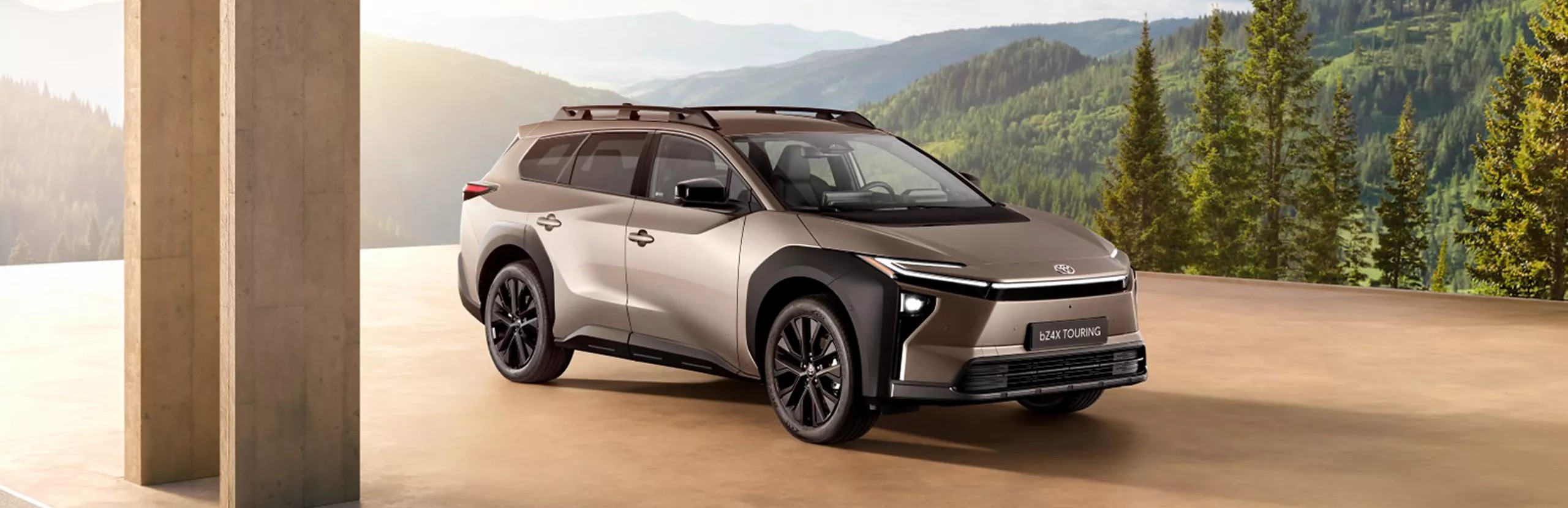
Toyota bZ4X Touring: comprehensive review, including towing capacity
The Toyota bZ4X Touring is a very interesting addition to the EV market because it combines the practicality of a large estate car with the raised stance, rugged styling and optional four-wheel drive of an SUV. It is designed for families who need substantial luggage space, people who enjoy outdoor activities, and drivers who want an electric vehicle that can do more than commute. Its towing capability is particularly important, because the difference between the front-wheel-drive and all-wheel-drive versions is substantial.
The Touring is an extended version of Toyota's updated bZ4X, with most of the extra length devoted to the luggage compartment rather than additional passenger space. It has a 74.7 kWh gross battery, a claimed range of up to 591 km in front-wheel-drive form, and up to 528 km with four-wheel drive on the European WLTP cycle, depending on specification. The AWD model also delivers 380 DIN horsepower and a maximum braked towing capacity of 1,500 kg. Those figures make it a more versatile proposition than many electric family cars, although its suitability for towing depends on which version you choose.
Design and overall character
The bZ4X Touring has a purposeful, slightly adventurous appearance. Its longer roofline and extended rear section give it a more estate-like profile than the standard bZ4X, while the raised ride height, wheel-arch cladding, roof rails and protective-looking bumper details reinforce its outdoors-oriented character. It looks more robust than a conventional electric estate without adopting the oversized proportions of some large electric SUVs.
At 4,830 mm long, 1,860 mm wide and 1,675 mm high, it is a sizeable family vehicle. The 2,850 mm wheelbase provides a generous foundation for passenger accommodation, while ground clearance of approximately 210 mm gives it an advantage over many ordinary estate cars when travelling on rough tracks, uneven campsite access roads or snow-covered surfaces. It is not a dedicated off-road vehicle, but its proportions and available AWD hardware make it more adaptable than its styling alone might suggest.
The principal design trade-off is its size. The long body is useful for carrying people and luggage, but it makes the Touring less compact in tight urban spaces and parking garages. The turning radius is reasonably manageable for a car of this size, though the width and length remain noticeable in narrow streets. Parking cameras and driver-assistance systems can help, particularly on higher specifications.
Interior, comfort and practicality
The Touring's strongest argument is its luggage space. Toyota quotes a 669-litre boot with the rear seats in place, increasing to 1,718 litres when they are folded. That is a substantial load area for a family EV and makes the car suitable for holidays, pushchairs, large shopping loads, outdoor equipment and bulky luggage. The relatively tall rear body should also make it easier to accommodate objects that would be awkward to fit into a lower, more coupe-like electric SUV. To increase versatility, we suggest fitting a towbar – must have accessory.
The rear seats are another important part of the package. The long wheelbase helps provide generous legroom, so adults should be comfortable on longer journeys rather than feeling that all the space has been sacrificed to the boot. The Touring makes sense for families with older children, as well as for adults who regularly carry passengers. Its five-seat configuration is conventional and useful, although buyers should check rear-seat comfort and seating position in person if three adults will frequently travel across the back.
Up front, the cabin follows the contemporary Toyota approach, with a digital instrument display, a large central touchscreen and a relatively uncluttered dashboard. The infotainment system supports Apple CarPlay and Android Auto, and the overall layout is intended to make everyday operation straightforward. Equipment varies by trim and market, so features such as premium audio, panoramic glass, ventilated seats, rear-seat heating and advanced parking assistance should be checked against the precise vehicle being ordered.
Cabin quality is best viewed as functional and modern rather than overtly luxurious. Toyota's strengths traditionally lie in usability and straightforward ownership, and that is the appeal here. The key questions for an individual buyer are whether the seats suit their body shape, whether the touchscreen controls are convenient, and whether the interior materials feel sufficiently premium for the purchase price.
There is one practical omission worth noting: the Touring does not have a conventional front boot, or frunk, according to the UK review by What Car?. That is not a deal-breaker, but it means charging cables and smaller items must be accommodated in the main luggage compartment or other available storage areas.
Driving experience, ride comfort and handling
On the road, the bZ4X Touring is designed to be a comfortable, quiet family car rather than a sporty SUV. Independent testing by RAC describes it as refined, with low levels of wind and road noise, little noticeable motor whine and a brake pedal that is relatively natural to modulate. These qualities are particularly valuable on long journeys, where a quiet cabin and predictable controls matter more than aggressive handling.
The suspension uses MacPherson struts at the front and a double-wishbone arrangement at the rear. This is a conventional but capable layout intended to balance stability, ride comfort and body control. The car should feel composed on motorways and ordinary country roads, although the optional 20-inch wheels and their lower-profile tyres may transmit more sharp-edged bumps than the 18-inch wheels. For drivers prioritising comfort, range and touring ability, the smaller wheels are worth serious consideration.
Steering is likely to feel light enough for everyday driving, with the raised driving position providing a useful view of the road. The Touring's length and weight mean that it is not likely to feel as nimble as a smaller hatchback, but its low-mounted battery helps keep the centre of gravity down. It is best understood as a stable, refined long-distance vehicle rather than a car built to entertain on twisting roads.
Performance and choice of drivetrain
The front-wheel-drive Touring produces 165 kW, equivalent to approximately 224 DIN horsepower, and accelerates from 0 to 100 km/h in 7.3 seconds. This is ample for ordinary family use, including joining fast-moving traffic and overtaking when conditions allow. Its single motor also makes it the more rational choice for drivers whose main priorities are range, efficiency and purchase cost.
The all-wheel-drive version is considerably more powerful. With an electric motor on each axle, combined output rises to 280 kW, or 380 DIN horsepower, and the claimed 0–100 km/h time falls to 4.5 seconds. That is exceptionally quick for a spacious family car. More importantly, the second motor gives it the ability to distribute drive across both axles, improving traction when pulling away on wet grass, snow, gravel or a slippery boat ramp.
The distinction is not simply between a slow and a fast version. It is between a more efficient road-focused car and a more versatile vehicle suited to towing and difficult surfaces. If you intend to pull a caravan or regularly launch a boat, the AWD version is the one to investigate.
Battery, range and charging
Both versions use a lithium-ion battery with a gross capacity of 74.7 kWh and a usable capacity of approximately 71 kWh. The front-wheel-drive model has the better official range, reaching up to 591 km on the WLTP cycle with the appropriate specification. The AWD version is rated at up to 528 km on 18-inch wheels, falling to approximately 479 km with 20-inch wheels. These are laboratory figures rather than guaranteed real-world distances.
In practice, motorway speeds, cold weather, cabin heating, headwinds, gradients, passengers and luggage can all reduce range. Winter driving in northern or central Europe is especially relevant because the battery must operate in colder conditions, while heating the cabin consumes energy. A heat pump is included in the UK model range, helping to reduce the energy penalty associated with cabin heating, and battery preconditioning helps prepare the battery for rapid charging.
The maximum DC charging rate is 150 kW, with Toyota quoting approximately 28 minutes for a 10–80% charge under suitable conditions. The car also supports AC charging, with the onboard charger depending on the version and market. Some specifications offer an 11 kW AC charger, while higher specifications in certain markets offer 22 kW. The exact specification is worth checking because it can make a meaningful difference when charging at public AC stations.
The advertised charging time is competitive, but it is important to distinguish peak charging power from average charging power. A charger rated at 150 kW does not supply that power continuously throughout the charging session. Battery temperature, state of charge and charger capability all affect the result.
For ordinary commuting and regional travel, the Touring should be easy to live with if home charging is available. For repeated long-distance journeys, charging stops need to be planned around the actual range at motorway speeds rather than the headline WLTP figure. For towing, that distinction becomes even more important.
Towing with the 2026 Toyota bZ4x Touring
The bZ4X Touring is unusually interesting among electric family cars because Toyota has given its AWD version a meaningful braked towing capacity. However, the front-wheel-drive model has a much lower limit, and published specifications differ by market. It is essential to check the homologated rating on the exact car you intend to buy rather than assume that all Touring models share the same capability.
Official towing figures
AWD 1,500 kg Maximum braked trailer
FWD, 750 kg Maximum
What does 1,500 kg mean in practice?
A braked towing limit of 1,500 kg makes the AWD Touring suitable for a useful range of small and medium-sized caravans, many camping trailers and some boat trailers. It is not a guarantee that every caravan with a quoted weight below 1,500 kg will be suitable. You must consider the caravan's actual loaded mass, the car's permissible gross vehicle weight, the maximum permitted train weight, and the towball load.
For a caravan owner, the distinction between the caravan's unladen weight and its actual laden weight is critical. Water, gas bottles, food, clothing, camping equipment, bicycles and accessories can add substantial mass. A caravan advertised at 1,300 kg empty could be significantly heavier when ready for a holiday. The correct comparison is between the actual loaded trailer and the towing limit, not the sales brochure's lightest figure.
A 1,500 kg limit is therefore useful for touring with a reasonably sized caravan, but it does not put the Toyota in the same category as a heavy-duty towing vehicle. If you have a large twin-axle caravan, a heavy horse trailer or a particularly heavy boat-and-trailer combination, check the actual figures carefully before considering a purchase.
The front-wheel-drive version is a much more restricted proposition. Its 750 kg rating limits it to lightweight trailers and smaller loads. It is not the version to choose if a substantial caravan is part of your plans.
How well should it tow?
Electric motors have an inherent advantage when moving a heavy load from rest. They deliver strong torque immediately, without needing to build engine speed or change through multiple gears. The AWD Touring's combined 380 horsepower should make pulling away, merging into traffic and climbing moderate gradients feel relatively effortless within the car's legal weight limits.
Four-wheel drive is also useful on wet roads and low-grip surfaces. This matters when manoeuvring a caravan on a damp campsite, pulling a boat up a slippery launch ramp or setting off on a snowy incline. Toyota's X-MODE traction system, Grip Control and downhill assistance are intended to help the AWD version maintain control on challenging surfaces. These systems improve traction and low-speed control, but they do not turn the Touring into a specialist off-road vehicle.
At motorway speeds, stability depends on the complete combination of car, towbar, trailer, load distribution, tyre pressures and driving conditions. The Toyota's substantial mass and long wheelbase are helpful foundations, but the maximum permitted towing weight alone cannot establish how stable a particular caravan will feel. I would want a proper towing test with a representative load before judging it against a dedicated diesel tow car.
Towing range and charging stops
The greatest compromise is energy consumption. Pulling a trailer increases aerodynamic drag and rolling resistance, while the extra mass requires more energy during acceleration and on gradients. A tall caravan is particularly demanding at motorway speeds because it presents a large area to the airflow.
Toyota does not publish a single guaranteed towing range for the bZ4X Touring, and it would be misleading to promise one. The actual distance between charging stops will depend on the trailer's shape, its weight, the speed travelled, weather, terrain and temperature. A relatively light, low trailer will normally be less demanding than a large, tall caravan.
For planning purposes, a caravan owner should expect the range per charge to be considerably lower than the official unladen WLTP figure. This can turn a journey that would otherwise require relatively few charging stops into one needing more frequent stops, especially in winter or on motorways. It is sensible to plan an initial towing journey conservatively, monitor energy consumption and leave enough reserve to reach a suitable charger.
Charging while towing also presents a practical challenge. Some charging sites have pull-through bays, but many do not. If you need to unhitch the caravan before charging, the extra time and inconvenience can become a significant part of the trip. Before buying an electric tow car, investigate charging locations along the routes you actually intend to travel and consider whether they can accommodate your complete combination.
Towball load, payload and legal limits
The 1,500 kg trailer rating is only one part of the towing calculation. The maximum permitted towball load, the vehicle's payload and its gross train weight also matter. The weight carried by the towball counts towards the car's loading, so occupants, luggage, accessories and the towball load must all fit within the vehicle's permitted limits.
This is especially relevant because the Touring is already a relatively heavy electric vehicle. Carrying five people and a full boot while towing a caravan can leave less payload available than expected. A roof box or roof-mounted equipment adds further weight, and any roof-load limit must also be respected.
Before purchasing, obtain the vehicle's Certificate of Conformity or relevant registration documentation and check the maximum braked and unbraked trailer weights, gross vehicle weight, gross train weight, axle limits and towball load. The figures on the specific car's documents take precedence over general figures quoted for the model range. Our towbars are rated at 150kgs download.
Ride quality and light off-road use
The Touring's raised ground clearance and AWD system give it a broader range of uses than a conventional low-slung electric estate. It should be comfortable on gravel roads, forest access tracks, uneven approaches to campsites and other surfaces encountered during outdoor holidays. Its long wheelbase and substantial weight, however, mean that deep ruts, sharp crests and soft ground still require care.
The AWD version's X-MODE system is especially relevant here. It adjusts power delivery and traction control for lower-grip conditions, while downhill assistance helps control progress on steep descents. These are useful systems for controlled progress on loose or slippery surfaces rather than equipment intended for extreme off-roading. Ground clearance is helpful, but the underbody, tyres and approach and departure angles remain important limitations.
For drivers who regularly tow a caravan onto wet grass or visit remote campsites, the AWD version offers a convincing combination of traction and practicality. For ordinary tarmac driving, the front-wheel-drive model may be perfectly adequate.
Safety and driver assistance
The bZ4X Touring benefits from Toyota's modern driver-assistance technology. Depending on specification, the equipment includes adaptive cruise control, lane assistance, blind-spot monitoring, automatic emergency braking and rear cross-traffic alerts. Higher trims may add a 360-degree camera system and advanced parking assistance. These features are particularly useful in a large car that may frequently carry a full complement of passengers and luggage.
Running costs and ownership
The principal running-cost advantage is the ability to charge at home. If you can charge overnight using a domestic wallbox and your electricity tariff is favourable, everyday driving can be substantially cheaper than running a comparable petrol or diesel SUV. Public rapid charging is generally more expensive per unit of energy, so the financial advantage narrows when most of your driving depends on motorway charging networks.
Tyres deserve particular attention. The Touring is heavy, and its immediate electric torque can increase tyre wear if driven aggressively. Towing adds further demands to the tyres and suspension. Choosing the correct load-rated tyres, maintaining the recommended pressures and adopting smooth acceleration should help keep wear under control.
Routine servicing is simpler in some respects than with an internal-combustion vehicle because there is no engine oil, exhaust system or conventional multi-speed gearbox to maintain. Nevertheless, the car still requires inspections, brake maintenance, tyre replacement, cabin-filter changes and battery-system checks according to Toyota's service schedule.
The Toyota's strongest point against rivals is the combination of a large luggage compartment, rugged styling, available AWD and a 1,500 kg towing capacity in the AWD specification. Its weaknesses are the substantial range penalty associated with the more powerful version, the need to plan charging carefully when towing and the possibility that a rival may offer better efficiency or faster charging in a particular configuration. The best choice therefore depends on whether towing and outdoor use are central requirements or occasional extras.
Value depends heavily on how the car will be used. For a household that can charge at home, needs a large boot and wants an electric car for daily journeys, the Touring makes a strong practical case. For a caravan owner, the calculation is more complicated: purchase price, electricity costs, insurance, charging stops and the frequency of long towing journeys all influence whether it makes sense.
If towing is central to your requirements, I would regard the AWD model as the appropriate starting point, even if you do not need its full acceleration. Its additional traction and higher permitted trailer weight are more important than its headline performance.
Final verdict
The Toyota bZ4X Touring is a convincing family electric car with a particularly useful blend of space, comfort and all-weather versatility. Its 669-litre boot, generous rear accommodation, quiet driving experience and strong AWD performance make it suitable for long family trips and active lifestyles. The charging system is competitive, and the battery size offers a useful balance between everyday efficiency and touring range.
Its towing credentials are good for an electric vehicle of this type, but they need to be understood in context. The AWD version's 1,500 kg braked towing limit is sufficient for many smaller caravans and trailers, while the FWD version's 750 kg rating is much more restrictive. The AWD model's traction systems and immediate torque should make it an appealing tow car on slippery surfaces and gradients, but towing will significantly reduce range and require more careful journey planning.
I would recommend the bZ4X Touring AWD to someone who wants a roomy electric family vehicle, needs to tow a moderately sized caravan or boat, and is comfortable planning charging stops around longer trips. I would be less enthusiastic about it for someone who regularly tows a large, heavy caravan over long motorway distances, where charging logistics and real-world range could become tiresome.
Overall, the Touring's biggest achievement is that it feels like a genuinely practical electric touring vehicle rather than simply a standard electric SUV with a larger boot. Its suitability as a tow car is real, provided the trailer is within the limits of the exact vehicle and you accept the compromises that come with towing an electric car.
Be sure to increase the practicality of your bZ4x Touring by fitting our invisible Toyota Towbar today!


 The tow bar becomes completely invisible - the lines of your car are not spoiled in the slightest.


 Select your Vehicle


