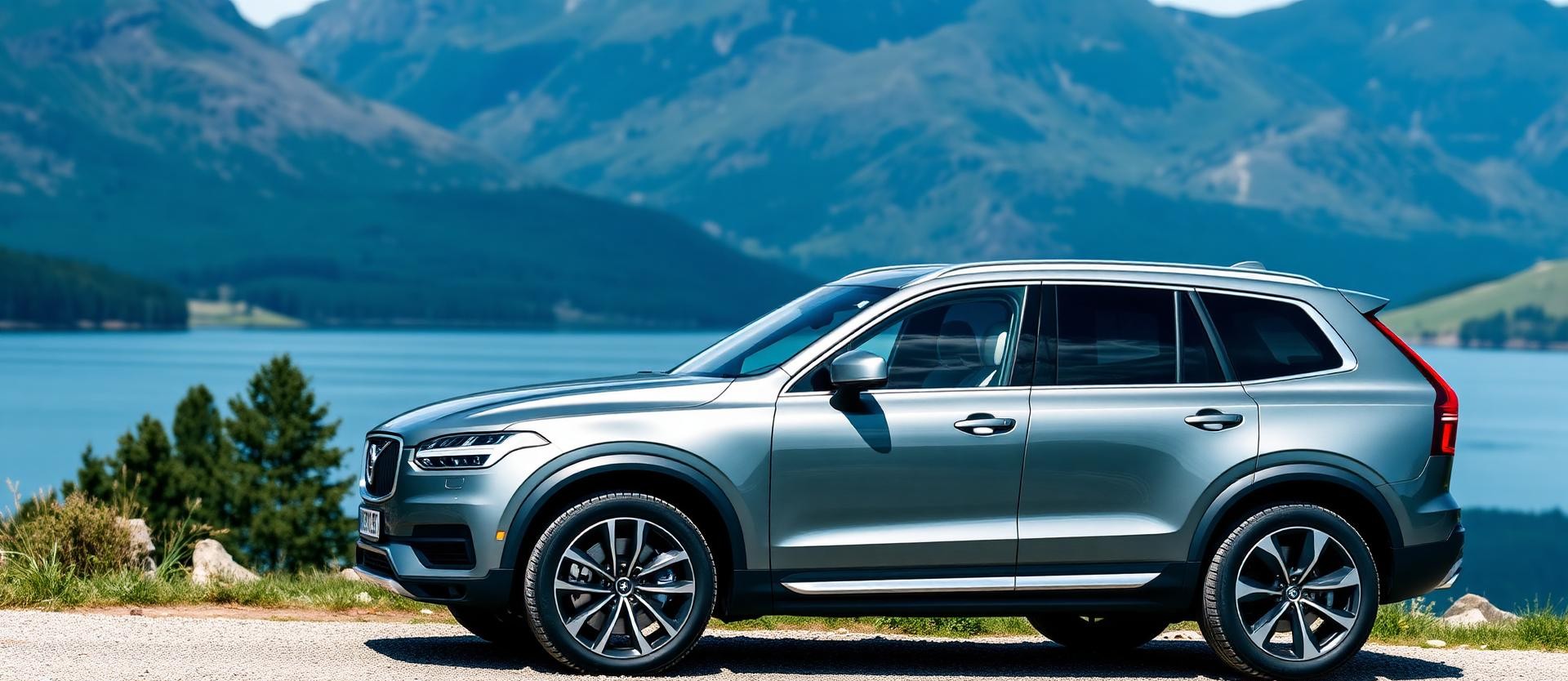
Volvo EX90: Comprehensive Towing Review
The Volvo EX90 is the company's flagship electric SUV and the electric successor to the role traditionally occupied by the XC90. It is a large, three-row luxury SUV designed around comfort, safety, practicality and long-distance travel rather than outright sporting ability.
At more than five metres long, with seating for up to seven people and a large battery, the EX90 is a substantial vehicle. Its defining character is not immediately apparent from its specification sheet, however. The car is less about spectacular performance or futuristic gimmicks and more about creating a quiet, spacious and sophisticated environment for travelling with a family.
The EX90 is also an important technological statement for Volvo. It was designed from the beginning as a software-defined vehicle, with a large central computer, extensive driver-assistance technology, over-the-air updates and Google's automotive software platform. That approach has been both one of its greatest strengths and one of its greatest weaknesses.
Exterior design
The EX90 is unmistakably a Volvo, but it represents a significant evolution of the company's design language.
Its bodywork is remarkably clean. There are few unnecessary creases or decorative elements, and the conventional grille has largely disappeared because an electric vehicle does not require one. The front is dominated by Volvo's distinctive headlights and a smooth, almost architectural surface.
The proportions are imposing. The EX90 is approximately 5.04 metres long and nearly two metres wide before accounting for the mirrors. It therefore has a substantial physical presence, although the minimalist design prevents it from looking excessively bulky.
The rear continues the restrained approach. Vertical lighting elements emphasize the height of the body, while the relatively upright tailgate makes clear that this is intended to be a practical family SUV rather than a coupe-like crossover.
The overall effect is understated rather than ostentatious. Where some luxury electric SUVs deliberately advertise their technological sophistication, the EX90 looks relatively conventional and mature.
That restraint is one of its most appealing characteristics.
Interior and cabin quality
The interior is perhaps the strongest part of the EX90.
Volvo has created a cabin that feels calm rather than technologically overwhelming. Materials, colours, lighting and surfaces are arranged around a minimalist Scandinavian aesthetic. There is very little visual clutter.
The quality is appropriate for a luxury SUV. The seats are particularly impressive, continuing Volvo's long-standing reputation for excellent ergonomics. Long-distance comfort is clearly one of the car's priorities.
The cabin also benefits from the inherent characteristics of an electric vehicle. There is no conventional engine occupying the front of the cabin, while the electric powertrain produces very little noise. At motorway speeds, the EX90 can therefore feel remarkably isolated from the outside world.
This quietness is an important part of its luxury character.
Instead of trying to impress occupants with the sheer quantity of technology on display, the EX90 attempts to make technology disappear into the background.
The infotainment system
The central 14.5-inch touchscreen dominates the dashboard.
The system is based on Google's automotive platform and incorporates Google Maps, Google Assistant and access to Google Play, while Apple CarPlay and Android Auto are also supported.
The system can integrate navigation with the vehicle's charging requirements, helping to plan routes around charging stations and estimate the battery level at the destination.
The approach is modern, but it is not without drawbacks.
Volvo has moved a significant amount of functionality onto the touchscreen. Functions that might traditionally have been controlled with physical buttons can require interaction with menus and on-screen controls.
This looks clean and modern when the car is stationary. While driving, however, the arrangement can sometimes feel unnecessarily complicated.
The minimalist dashboard therefore comes with a trade-off: it looks excellent, but the interface is not always as intuitive as a collection of dedicated physical controls would be.
Space and practicality
The EX90 is fundamentally a family vehicle, and its dimensions make sense once you experience the interior.
It can accommodate six or seven occupants depending on configuration. More importantly, the third row is genuinely usable rather than being an occasional emergency space.
This is one of the EX90's most significant advantages over many luxury electric SUVs.
With all three rows occupied, there remains useful luggage space. Folding the rear seats transforms the vehicle into a very substantial cargo carrier, while the front storage compartment provides additional capacity.
The second row provides generous space, and the overall feeling is of a vehicle designed around transporting people rather than simply offering a large exterior footprint.
The six-seat configuration, with individual second-row seats, gives the cabin a particularly luxurious character. The seven-seat configuration is more versatile and arguably makes more sense for a family that intends to use the EX90's full carrying capacity.
The third row
The third row deserves particular attention because it changes the role of the EX90.
Many large SUVs technically have seven seats but are really five-seat vehicles with two additional seats intended for occasional use.
The EX90 is much closer to a genuine seven-seat vehicle.
Adults can use the third row for reasonable journeys, while children have considerably more space. The relatively upright body also makes entering and leaving the third row easier than in many sloping-roof SUVs.
This makes the EX90 particularly convincing as an alternative to a conventional large family SUV.
Driving experience
The EX90 is not designed to be a sports SUV.
Its character is relaxed, stable and extremely quiet.
The steering is accurate but deliberately lacks the communicative quality of something such as a BMW. The car does not encourage aggressive cornering, and its considerable weight becomes apparent when it is pushed hard.
That is not necessarily a criticism.
The EX90's purpose is to make long journeys easy. The suspension, seats, low noise levels and smooth electric powertrain work together to create a remarkably effortless driving experience.
On a motorway, the car feels particularly well suited to its role. It settles into a steady pace and isolates occupants from much of the road and wind noise.
Around town, its dimensions become more noticeable. At more than five metres long and almost two metres wide, it is a large vehicle, and parking cameras and assistance systems are particularly useful.
Ride comfort
Ride comfort is one of the EX90's strongest characteristics.
The substantial weight of the vehicle and its sophisticated suspension allow it to absorb many road imperfections without transmitting excessive movement into the cabin.
The result is a feeling of solidity rather than agility.
The car does not dance over a road. Instead, it moves across it with considerable composure.
Large wheels can inevitably reduce ride quality somewhat, particularly over sharp imperfections, so wheel and tyre selection matters. For an EX90 intended primarily for long-distance family use, comfort-oriented specifications make more sense than maximising wheel size.
Performance
The EX90 is available with different power outputs, ranging from a single-motor rear-wheel-drive version to an extremely powerful dual-motor Performance model.
The single-motor version produces 333 horsepower and accelerates from zero to 100 km/h in approximately 6.8 seconds.
That is already substantial performance for a vehicle of this size.
The standard Twin Motor produces 456 horsepower and reaches 100 km/h in approximately 5.5 seconds.
The Twin Motor Performance increases output to 680 horsepower and reduces the acceleration time to approximately 4.2 seconds.
The numbers are remarkable considering the vehicle's size.
The Performance version can therefore deliver genuinely sports-car-like acceleration from a seven-seat luxury SUV.
In practice, however, the standard Twin Motor is already extremely quick. Its acceleration is more than sufficient for motorway overtaking, merging and carrying a full load of passengers.
The additional performance of the 680-horsepower version is impressive but not particularly necessary for the EX90's fundamental purpose.
Electric range
The EX90's range varies according to battery, drivetrain, wheels and specification.
The largest-battery versions are rated at up to approximately 625 kilometres under the WLTP testing procedure, while the single-motor version has a slightly lower maximum official range.
As with every large electric vehicle, the official figure should not be confused with motorway range.
Real-world consumption depends heavily on temperature, speed, wind, tyres, wheel size, heating and the number of passengers.
The EX90's substantial size and weight mean that motorway driving at high speeds can reduce range considerably.
Nevertheless, the vehicle has enough battery capacity to make it a credible long-distance electric SUV rather than simply a large urban vehicle.
Charging
Charging is particularly important for a vehicle of this size because its main purpose includes long-distance travel.
The newer EX90 architecture uses an 800-volt electrical system, allowing substantially faster DC charging than the earlier versions.
Volvo quotes charging from approximately 10 to 80 percent in as little as 22 minutes under appropriate conditions with a sufficiently powerful charging station.
This is a significant improvement and makes the EX90 much better suited to long-distance journeys.
The practical advantage is not simply the maximum charging speed. It is the ability to add a meaningful amount of range during a relatively short stop.
At home, the vehicle can be charged using an 11-kW AC connection. Overnight charging is therefore straightforward for owners with suitable home charging equipment.
Safety
Safety remains central to the EX90's identity.
The vehicle incorporates an extensive collection of cameras, radar sensors, driver monitoring and other sensing systems designed to monitor both the environment around the vehicle and the driver's condition.
Its driver-assistance systems can provide collision warnings, emergency braking, lane assistance and other forms of active intervention.
The EX90 has also received a five-star Euro NCAP safety rating, with particularly strong scores for adult and child occupant protection.
The vehicle's safety technology is closely connected to its computing architecture. Volvo's long-term ambition is for the vehicle to become increasingly capable through software updates rather than remaining fixed at the capabilities it possessed when it left the factory.
That is an important part of the EX90 concept.
Lidar and sensing technology
The EX90 was originally presented with lidar as one of its defining technological features.
The sensor is mounted above the windscreen and is intended to provide detailed information about objects and the road environment ahead.
However, Volvo has subsequently produced some versions without lidar, meaning that equipment should be checked on the specific vehicle rather than assumed from the model name.
This is an important distinction when comparing individual cars.
Software and reliability
This is the most complicated part of the EX90 story.
The physical vehicle is extremely impressive, but the early software experience was considerably less convincing.
The EX90 launched with a very ambitious electronic architecture and a large amount of software functionality. Early vehicles experienced various software and electronic issues, including problems involving infotainment, charging and individual vehicle functions.
This is particularly significant because the EX90 is not simply an electric version of an existing Volvo. It represents a new technological architecture for the company.
Volvo has responded with software updates and hardware improvements.
The company has also introduced a more powerful central computing platform, and qualifying earlier vehicles can receive a central-computer upgrade.
The newer versions therefore represent a substantially more mature product than the earliest examples.
Nevertheless, buyers should distinguish between the excellent potential of the EX90's architecture and its demonstrated long-term reliability. The vehicle is still relatively new, and there is not yet a long history demonstrating how all of its electronic systems will perform over many years.
The difference between early and newer EX90s
This distinction is extremely important when evaluating the vehicle.
The earliest EX90s used the original electronic and charging architecture and arrived during a period when Volvo was still developing a considerable amount of the software.
Later versions have benefited from a more powerful computing platform, an 800-volt electrical architecture and continuing software development.
Consequently, an early used EX90 and a current-production EX90 should not automatically be treated as equivalent products.
Someone considering an early car should establish which software updates and hardware upgrades have been completed and whether there are any outstanding service campaigns.
Comfort on long journeys
The EX90's greatest strength becomes most apparent after several hours behind the wheel.
The seats are comfortable, the cabin is quiet, the suspension is composed and the electric powertrain is exceptionally smooth.
There is very little drama.
That is exactly what makes it attractive.
The car does not constantly remind you that you are driving an electric vehicle. Instead, it attempts to provide the effortless experience associated with a large luxury touring vehicle.
The high seating position, spacious cabin and large glass areas reinforce that feeling.
Towing
The Twin Motor versions can tow up to approximately 2,200 kilograms, making the EX90 considerably more versatile than many electric SUVs.
It can therefore be used with substantial trailers, caravans and recreational equipment.
The obvious limitation is range.
Towing a large trailer can increase aerodynamic resistance dramatically, particularly at motorway speeds. The EX90 remains capable of towing, but long journeys with a trailer will require substantially more frequent charging.
Ownership experience
Ownership of the EX90 is likely to be very different depending on how much of the vehicle's technology is appreciated and how tolerant the owner is of software evolution.
The basic electric drivetrain should require less routine mechanical maintenance than a comparable combustion SUV.
There is no conventional engine oil, exhaust system or multi-speed combustion drivetrain to service.
However, the EX90 contains a large number of electronic systems, sensors, computers and software-controlled functions.
That means that the nature of potential problems changes.
Instead of a mechanical component simply wearing out, an owner may encounter a software error, sensor issue or electronic module that requires an update or dealer intervention.
The long-term reliability of these systems is therefore one of the major unanswered questions surrounding the model.
The EX90's character
The most interesting thing about the EX90 is that it is not trying to be everything.
It is not the most entertaining large electric SUV.
It is not the smallest or most efficient.
It is not the simplest.
It is not the fastest in its segment.
Instead, it concentrates on a particular combination of characteristics: space, silence, safety, comfort, technology and understated luxury.
That combination works extremely well.
The vehicle feels particularly coherent when used as intended: carrying a family over long distances in a quiet and comfortable environment.
Principal strengths
The EX90's strongest characteristics are its spacious three-row interior, excellent seats, exceptional cabin quietness, understated design and impressive long-distance comfort.
Its electric powertrains provide far more performance than most owners will ever need, while the newer 800-volt architecture makes fast charging substantially more practical.
The safety package is comprehensive, and the vehicle's underlying electronic architecture gives it considerable potential for future development.
Principal weaknesses
The most significant weakness remains software maturity.
The early cars demonstrated that Volvo's ambitious electronic architecture was not completely mature at launch.
The touchscreen-heavy interface is another weakness. The minimalist cabin looks excellent, but some everyday functions would be easier to use with conventional physical controls.
The EX90 is also extremely large and heavy. Its dimensions are an advantage for interior space but a disadvantage in confined urban environments.
Finally, its real-world energy consumption can be considerable at high speeds, particularly in cold weather.
Overall assessment
The Volvo EX90 is one of the most convincing large electric SUVs when considered purely as a luxury family vehicle.
Its greatest achievement is not its acceleration, its screen or its computing hardware. It is the way those elements come together to create a remarkably quiet, spacious and comfortable environment.
The three-row layout is genuinely useful, the seats are excellent, the ride is refined and the cabin has a distinctive sense of Scandinavian calm.
The major qualification is technology maturity.
The early EX90 demonstrated the risks of launching a highly software-dependent vehicle before every element of the system was fully mature. Volvo has subsequently made reason, the EX90 is best understood as a vehicle that has evolved significantly since its introduction. The newer versions are much more compelling than the substantial improvements, particularly with the newer computing hardware and 800-volt electrical architecture.
For that reason, the EX90 is best understood as a vehicle that has evolved significantly since its introduction. The newer versions are much more compelling than the earliest cars, while anyone considering an early used example should pay particular attention to its software version, hardware upgrades and service history.
Ultimately, the EX90 makes the most sense for someone who values comfort, space, safety and refinement above driving excitement.
Its defining quality is serenity.
It is a large electric SUV designed to make carrying seven people over long distances feel effortless, and when it succeeds, it is exceptionally good at that job.
Towing with the Volvo EX90
The Volvo EX90 is particularly well suited to towing because of its size, weight and electric drivetrain. It feels substantial on the road, and that character becomes especially noticeable when a trailer is attached. Rather than feeling strained under load, the EX90 has an effortless quality that is well suited to pulling a heavy trailer.
The Twin Motor versions can tow up to 2,200 kg, while the Single Motor version is rated for 1,500 kg. The Twin Motor Performance has the same 2,200-kg maximum as the regular Twin Motor, so its additional power does not translate into a higher towing capacity.
A natural towing vehicle
One of the EX90's biggest advantages is its sheer mass. The vehicle weighs well over two tonnes before a trailer is connected, and the battery is positioned low beneath the passenger compartment. This gives the EX90 a low centre of gravity and a reassuringly planted character.
With a trailer behind it, the car feels stable rather than nervous. Its long wheelbase also contributes to a composed feeling when changing direction or travelling at motorway speeds.
The electric motors add another important advantage. There is no need to build engine revs or wait for a transmission to select the appropriate gear. The Twin Motor produces substantial torque immediately, allowing the EX90 to move away from a standstill with a heavy trailer attached with very little effort.
This is particularly noticeable on gradients. A conventional combustion SUV may need to work its engine and transmission considerably harder when starting uphill with a heavy caravan. The EX90 simply applies its electric torque and moves forward smoothly.
The experience behind the wheel
Towing changes the character of the EX90 less than it does many lighter vehicles.
Without a trailer, the EX90 is a quiet and relaxed SUV. With a trailer attached, it becomes even more deliberate. Acceleration is naturally slower, but there is still considerable reserve power.
The steering remains predictable, while the weight of the vehicle gives the driver a feeling of security. The EX90 does not feel as though the trailer is dictating what the car does.
That does not mean that trailer dynamics can be ignored. A poorly loaded trailer can still sway, particularly at higher speeds or in crosswinds. The EX90's electronic stability systems can help manage such situations, but correct trailer loading, appropriate nose weight and suitable tyres remain essential.
Where the limitations appear
The biggest compromise is not power.
It is range.
An electric vehicle already consumes more energy at motorway speeds than it does around town. Add a large trailer and the aerodynamic drag can increase dramatically.
A caravan is particularly demanding because it is tall and wide. At motorway speeds, the air resistance created by the caravan can become the dominant factor in energy consumption.
The EX90 therefore moves from being a long-range electric SUV to something that needs considerably more deliberate journey planning.
A trailer weighing close to the maximum 2,200 kg can have a substantial effect on consumption. The exact impact depends on the trailer's height, width, shape, speed, weather and road conditions, so there is no single towing-range figure that applies to every situation.
Towing a caravan
The EX90 is particularly appealing as a caravan tow car.
Its cabin is spacious and comfortable, its seats are designed for long journeys and the electric drivetrain is exceptionally smooth. There is none of the vibration or engine noise associated with towing a heavy caravan with a conventional combustion engine.
The ability to produce substantial torque at very low speeds is also useful when manoeuvring a caravan.
Reversing into a campsite, moving a caravan up a driveway or positioning it on a pitch can feel remarkably controlled.
The vehicle's cameras and parking systems are also valuable when manoeuvring with a trailer, although the driver still needs to understand the trailer's movement and dimensions.
Long-distance caravan travel
This is where the EX90 requires more planning.
Suppose you are travelling several hundred kilometres with a large caravan. The vehicle may need considerably more charging stops than it would without the trailer.
The newer 800-volt EX90 helps because its charging capability is substantially faster than that of the original architecture. Under ideal conditions, Volvo quotes approximately 10 to 80 percent charging in as little as 22 minutes.
In practice, however, towing introduces another complication: the charging station itself.
A long vehicle with a caravan attached can occupy considerably more space than a normal charging bay allows. Some charging locations make it possible to pull through with a trailer, while others require the trailer to be disconnected before charging.
For long-distance towing, choosing appropriate charging locations can therefore be almost as important as calculating the distance between them.
Descending hills
The EX90's regenerative braking is particularly useful when towing.
A heavy combination contains a great deal of kinetic energy. When the driver slows down, the electric motors can recover some of that energy and return it to the battery.
On long descents, this can provide useful additional control and reduce reliance on the conventional brakes.
The system does not eliminate the need for properly functioning trailer brakes. A heavy trailer must be equipped and operated according to its legal and technical requirements.
The Twin Motor advantage
For serious towing, the Twin Motor is the more appropriate EX90.
The Single Motor can tow 1,500 kg, which is enough for many smaller trailers. But the Twin Motor's 2,200-kg rating opens up considerably more possibilities.
Its all-wheel drive is also useful when pulling a heavy trailer from a wet campsite, launching a boat or dealing with slippery surfaces.
The standard Twin Motor already has 456 horsepower and 670 Nm of torque. There is therefore little practical reason to choose the 680-horsepower Performance version specifically for towing.
The Performance version is dramatically quicker, but it does not increase the maximum trailer rating.
The sensation of towing with an EX90
Perhaps the best way to describe the experience is effortless rather than powerful.
The EX90 does not feel like a performance car dragging a trailer behind it. Instead, it feels like a large, heavy vehicle that happens to have a substantial amount of electric power available whenever it is needed.
The cabin remains quiet. The drivetrain remains smooth. There are no gear changes. The vehicle feels settled and substantial.
That makes it an appealing tow vehicle for families who spend long periods travelling with a caravan or trailer.
The compromise comes when the journey becomes very long and charging becomes necessary.
Overall
The EX90 is one of the more convincing electric SUVs for towing because the fundamentals are right: it is large, heavy, powerful, stable and available with a 2,200-kg towing capacity.
Its weakness is not its ability to pull a trailer. It is the amount of energy required to pull one at motorway speeds.
For local towing, weekend trips, boat launching, horse trailers and moderate-distance caravan journeys, the EX90's characteristics are particularly well suited to the task.
For very long-distance caravan travel, the experience becomes more dependent on charging infrastructure and careful route planning.
The result is a vehicle that is an excellent tow car, but a more demanding long-distance tow car than its impressive battery capacity might initially suggest.
Order our Invisible Volvo EX90 towbar today!


 The tow bar becomes completely invisible - the lines of your car are not spoiled in the slightest.

 Select your Vehicle


