Towing with the 2026 Foton Tunland V9 – need a V9 towbar?
The 2026 Foton Tunland V9 represents a significant step forward for Foton as it attempts to move from budget-focused utility vehicles into a more premium, lifestyle-oriented pickup segment. Positioned above the more work-centric Tunland variants, the V9 is clearly designed to compete not just on price, but on presence, comfort, and technology. It is a large, imposing dual-cab pickup that blends American-inspired styling with Chinese manufacturing pragmatism and an increasingly global feature set.
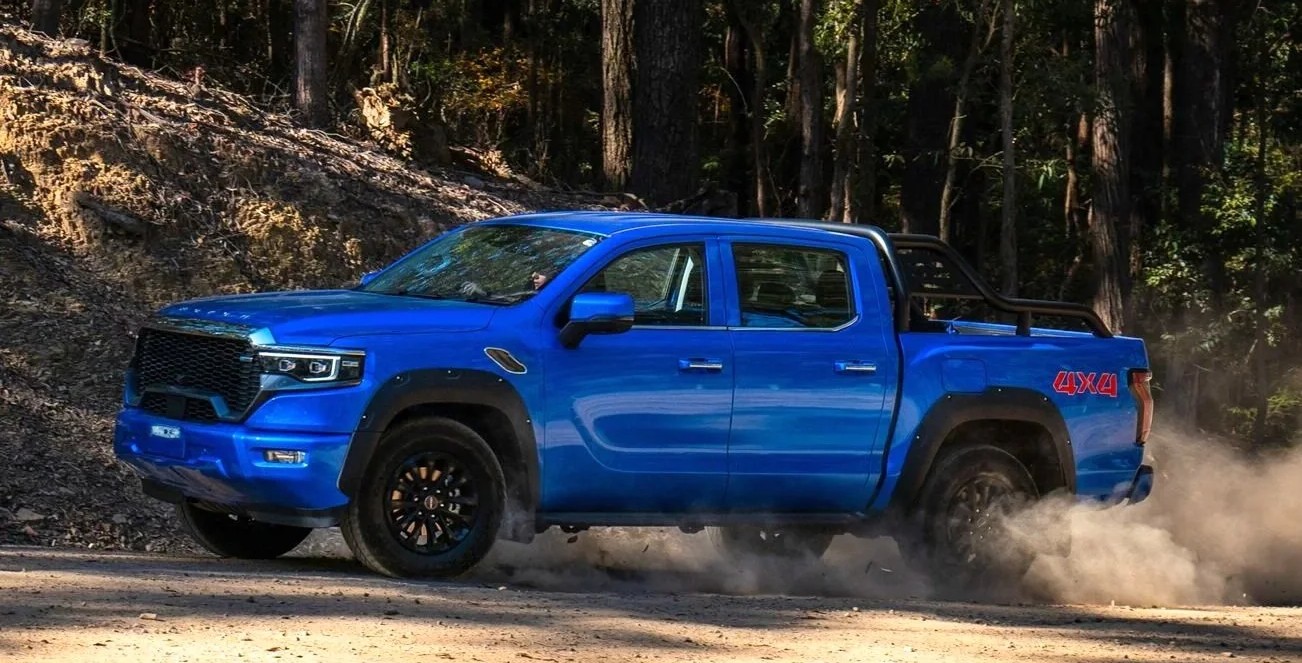
Visually, the Tunland V9 is unmistakably bold. Its massive front grille, squared-off proportions, high bonnet line, and stacked LED lighting elements give it a stance that feels closer to a full-size American truck than a traditional midsize ute. At over 5.6 metres in length and with a wide body approaching 2.1 metres including mirrors, it has genuine road presence. The wheelbase stretches beyond 3.3 metres, which contributes not only to its planted look but also to interior space. Ground clearance sits around 240 mm, and the claimed wading depth of roughly 700 mm positions it as a serious off-road contender on paper. The tray dimensions are competitive for the class, offering practicality for both work and recreational buyers.
Under the bonnet, the V9 runs a 2.0-litre turbo-diesel engine paired with a 48-volt mild-hybrid system. Output figures hover around 120 kW and 450 Nm of torque. While the torque figure is respectable and arrives relatively low in the rev range, the power output is modest considering the truck’s size and kerb weight. In real-world driving, the V9 feels adequate rather than quick. Acceleration from a standstill is steady but unhurried, and overtaking at highway speeds requires deliberate throttle input. The mild-hybrid system functions primarily as a torque assist and efficiency aid rather than a performance enhancer. It smooths take-off from rest, slightly reduces turbo lag, and helps with stop-start refinement, but it does not transform the driving experience.
One of the mechanical highlights is the eight-speed automatic transmission sourced from ZF, a well-regarded supplier. Gear shifts are generally smooth and well-timed, and the transmission helps extract the best from the relatively modest engine output. Four-wheel drive is selectable, and drive modes typically include settings for eco, sport, sand, mud, and snow. Higher-spec V9 variants use a multi-link rear suspension rather than traditional leaf springs, which is unusual in this segment. This setup delivers a noticeably more compliant and SUV-like ride, particularly when unladen. Over broken urban surfaces and highway expansion joints, the V9 feels more composed than many traditional workhorse utes. However, under heavy load, some drivers may prefer the durability and predictability of leaf springs.
On the road, the steering is light and easy to manage at low speeds, which helps in urban driving despite the truck’s size. Feedback through the wheel is limited, and there is some body roll when cornering quickly, which is expected given its height and suspension tuning. Noise levels are acceptable but not class-leading. At idle and under hard acceleration, the diesel engine produces a coarse note, and wind noise becomes noticeable at highway speeds. It is not uncomfortable, but it lacks the polished refinement found in segment leaders.
Inside, the Tunland V9 makes its strongest case. The cabin is surprisingly upscale for a brand that historically focused on value. Soft-touch materials are used across much of the dashboard and door trims, and the seats are often finished in quilted synthetic leather with contrast stitching. The overall design feels modern and cohesive, with a prominent central touchscreen measuring approximately 14.6 inches and a 12.3-inch digital instrument cluster. The infotainment system supports Apple CarPlay and Android Auto in most markets, and the graphics are sharp, though menu logic can take some familiarization. Climate controls are generally integrated into the screen, which may not appeal to buyers who prefer physical buttons.
Rear seat space benefits from the long wheelbase, offering generous legroom for adult passengers. The backrest angle is comfortable for a pickup, and there are multiple USB ports and air vents to improve passenger comfort. Storage solutions throughout the cabin are well thought out, with large door bins, a sizeable center console, and practical compartments for everyday items. Some markets also receive features such as a 220-volt power outlet, heated and ventilated front seats, and even a panoramic sunroof in higher trims, reinforcing the V9’s lifestyle aspirations.
In terms of safety and driver assistance, the V9 is equipped with a suite that aligns with Level 2 semi-autonomous capability in many specifications. This typically includes adaptive cruise control, lane-keeping assist, automatic emergency braking, blind-spot monitoring, and a 360-degree camera system. While the feature list is comprehensive, calibration and system smoothness may vary by market. Independent crash-test ratings have not been widely published in all regions as of early 2026, which may give some cautious buyers pause.
Towing capacity is generally rated at around 3,500 kg, putting it in line with class expectations, and payload figures approach the one-tonne mark depending on configuration. For buyers who need genuine work capability but also want family-friendly comfort, the V9 strikes an interesting balance. However, long-term reliability and parts availability remain question marks in certain markets where Foton’s dealer network is still developing.
With the 2026 Foton Tunland V9, towing capability is one of its stronger practical points, and it largely matches what you’d expect from a modern dual-cab ute in this class. Across the V9 range — whether you’re looking at the V9-L or V9-S variants — the rated braked towing capacity is 3,500 kg. That means the truck can legally tow a trailer, caravan, boat or similar load up to that weight provided the trailer has its own brakes. This 3.5-tonne rating places it alongside many class rivals such as the Toyota Hilux and Ford Ranger, which also commonly offer similar 3,500 kg limits in dual-cab, diesel-powered form, although individual figures can vary by market and configuration.
Unbraked towing — that is, without trailer brakes — is rated at 750 kg, which is typical for smaller, unbraked trailers. You always need to stay within these limits, because exceeding the ball download can overload the rear suspension and compromise steering and braking.
In practical terms, those figures mean the V9 can handle fairly large caravans and trailers. With a braked capacity of 3,500 kg, you could tow a mid-size caravan or a large boat on a trailer, assuming you manage your payload and Gross Combination Mass (GCM) correctly. The rated GCM — the total permissible mass of the vehicle plus the trailer — sits at about 6,810 kg, and the pickup’s own Gross Vehicle Mass (GVM) is around 3,310 kg. Keeping within those limits is essential: if you load the cabin with passengers, fuel, gear and accessories, that eats into the GVM and reduces the amount you can safely tow without exceeding legal weight limits.
It’s worth noting that maximum towing figures are rated under ideal conditions — flat roads, correct hitch setup, proper trailer brakes, good tyres, and a level load distribution. Real-world towing performance can depend heavily on how you load the trailer, road gradients, weather, and how well you manage heat in the transmission and brakes during long tows. Always consult the owner’s manual for specific guidelines on tongue weight, trailer braking requirements, and recommended towing speeds.
In summary, the 2026 Foton Tunland V9’s towing credentials are straightforward and competitive: 3,500 kg braked, 750 kg unbraked. This makes it capable of handling the types of trailers and caravans typical for work and recreational use — as long as you stay within the legal mass limits and load the vehicle and trailer appropriately
When compared with established rivals such as the Toyota Hilux, the Mitsubishi Triton, and the GWM Cannon, the Tunland V9 stands out for its interior presentation and value proposition. It often undercuts these competitors on price while matching or exceeding them in standard equipment. Where it falls short is in engine performance, brand reputation, and the long track record of durability that Japanese manufacturers have cultivated over decades.
Overall, the 2026 Foton Tunland V9 is a confident and ambitious product. It demonstrates how rapidly Chinese manufacturers are closing the gap in terms of design, technology, and perceived quality. It is not the most powerful or the most refined pickup in its class, but it offers a compelling blend of size, comfort, and features at a competitive price. For buyers willing to prioritize equipment and cabin comfort over outright performance and established brand heritage, the V9 is a serious contender in the modern dual-cab pickup market.
Need to increase the functionality of your Tunland V9? Order our Foton Tunland V9 towbar today!


 The tow bar becomes completely invisible - the lines of your car are not spoiled in the slightest.

 Select your Vehicle


