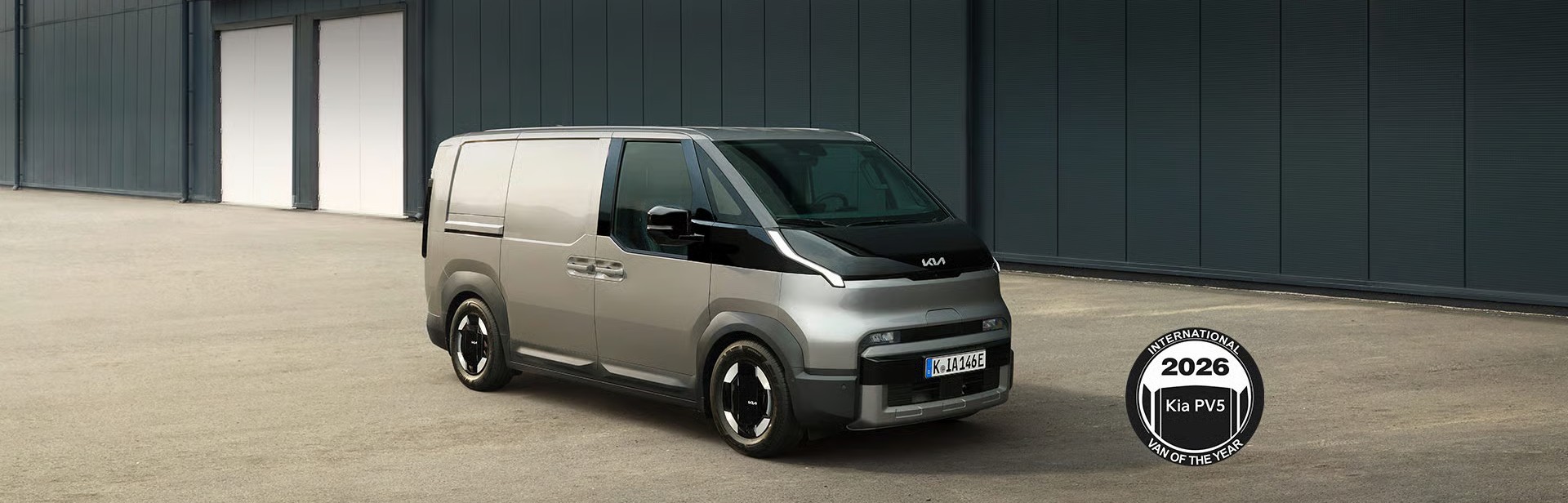
Everything you need to know about towing with the Kia PV5 Cargo Long. Need a PV5 Towbar?
The Kia PV5 Cargo Long is a significant step for Kia, not just because it’s electric, but because it’s designed from the ground up as a commercial vehicle rather than adapted from a passenger car. That distinction shapes almost every aspect of how it drives, how it works, and who it’s really for.
At a glance, the PV5 Cargo Long sits in the compact van segment, but it stretches the category in a few directions. It’s larger and more versatile than traditional small vans like the Peugeot e-Partner, yet more utilitarian and cost-focused than lifestyle-oriented models such as the Volkswagen ID. Buzz Cargo. The “Long” version specifically adds meaningful cargo length and volume, making it the configuration that most professionals will actually consider.
From a design perspective, the van looks modern without trying too hard to be futuristic. The shape is clean and functional, with a high roofline and upright stance that maximize usable interior space. It doesn’t have the visual charm of the ID. Buzz, but it also avoids gimmicks. Everything about it signals that it’s built to work first and impress second.
On the road, the PV5 makes a strong initial impression through refinement rather than performance. The electric drivetrain is smooth and quiet, and the absence of engine vibration gives it a more relaxed feel than diesel vans. Acceleration is adequate rather than quick, but in daily use—especially in urban environments—it feels responsive enough. Where it stands out most is ride comfort. The suspension is tuned on the softer side, which helps it absorb rough surfaces and potholes better than many rivals. Over longer drives, that translates into less fatigue.
However, that same softness comes with trade-offs. When the van is fully loaded or driven aggressively over uneven roads, the front end can feel less controlled, and there are reports of the nose dipping or even lightly scraping on sharper bumps. Traction can also be an issue. Because it’s front-wheel drive with instant electric torque, it’s possible to spin the wheels under load, particularly in wet conditions. This isn’t unusual for electric vans, but it’s noticeable here.
The battery and efficiency are among the PV5’s strongest points. The larger battery option delivers a claimed range of just over 400 km WLTP, and early real-world testing suggests it comes surprisingly close to that figure under mixed conditions. That’s important, because many electric vans fall short of their official numbers once loaded or driven at speed. The PV5 appears more honest in that regard. Charging performance is competitive, with fast-charging capability that makes it viable for fleet use, provided infrastructure is available.
Where the PV5 really distinguishes itself is in practicality. The cargo area is well thought out, with a flat floor and a low loading height that makes repetitive loading and unloading easier on the body. The Long version offers over four cubic meters of space, and the extended load length allows it to handle bulkier items that wouldn’t fit in shorter vans. It can carry two Euro pallets, though the side door opening is not as wide as it could be, which limits how easily those pallets can be loaded from the side.
Kia has also introduced a modular approach to the interior and cargo space. The system allows businesses to configure shelving, storage, and specialized equipment more flexibly than in traditional vans. Combined with vehicle-to-load functionality, which lets you power tools directly from the van’s battery, it becomes more than just a transport vehicle—it starts to function as a mobile workspace.
Inside the cabin, the PV5 leans heavily toward a car-like experience. The driving position is comfortable, visibility is generally good to the sides and rear, and there’s a strong emphasis on storage. There are numerous compartments, trays, and clever spaces for tools, documents, and personal items. However, forward visibility is slightly compromised by thick front pillars, which can be noticeable at junctions.
The technology is modern and clearly derived from Kia’s passenger cars. A large central touchscreen handles most functions, supported by a digital instrument cluster. Navigation, connectivity, and driver assistance systems are all up to current standards. That said, the reliance on touch controls can be frustrating in a working vehicle where quick, tactile adjustments are often preferable. The materials inside are durable but not particularly premium, which makes sense given the van’s intended use, though some drivers may find them a bit plain.
In terms of cost and value, the PV5 is positioned very aggressively. It undercuts many electric rivals while offering more advanced architecture and better real-world usability. When combined with Kia’s long warranty, it becomes especially appealing to small businesses and fleet operators looking to transition to electric vehicles without excessive upfront cost.
There are still limitations. The payload is not class-leading, which may matter for heavier-duty applications. High-speed efficiency drops off, as expected with electric vans, making it less ideal for constant motorway driving. And as a first-generation product, there are small rough edges in areas like software responsiveness and overall polish.
Towing with the Kia PV5 Cargo Long is possible, but it’s important to understand from the outset that this van was not engineered as a primary towing vehicle. Its capabilities are real, but clearly limited, and they reflect its core purpose as an efficient urban cargo EV rather than a workhorse for hauling heavy trailers.
The official towing capacity ranges from 750 – 1500 kilograms for a braked trailer – depends on exact specifications and region. This figure immediately places it in the light-duty category. In practical terms, it means the PV5 is suitable for small utility trailers, light equipment, or occasional extra cargo beyond what fits inside the van. It is not intended for large caravans, heavy machinery, or frequent long-distance towing. We have a towbar with a max rating of 1500kgs – remember you cannot tow more than your KIA PV5 is rated for, irrespective of the towbar fitted. Check your owner’s manual.
The reasons behind this limitation are rooted in the vehicle’s design. The PV5 uses a front-wheel-drive layout, which is not ideal for towing because all the pulling force is handled by the front axle. When a trailer is attached, weight shifts toward the rear of the vehicle, reducing traction at the front wheels. This can lead to wheelspin, especially when starting on inclines or driving in wet conditions. While the electric motor provides smooth and immediate torque, which makes pulling away easy under light loads, that same instant torque can overwhelm available grip when the van is heavily loaded or towing near its limit.
Braking performance is another critical factor. Electric vans like the PV5 are already relatively heavy due to their battery packs, and adding a trailer increases stopping distances significantly. Even though regenerative braking helps in normal driving, it becomes less effective when towing because the trailer pushes forward under deceleration. For that reason, the towing limit is set conservatively to ensure the vehicle can still stop safely under all conditions.
Range is also affected in a noticeable way. While the PV5 in its long-range configuration can achieve around 400 kilometers under normal conditions, towing reduces that figure considerably. A realistic expectation is a reduction of roughly 20 to 40 percent, depending on the trailer’s weight, shape, and the driving environment. Aerodynamics play a surprisingly large role here. A tall, boxy trailer creates much more drag than a low, compact one, and can reduce range even more than additional weight alone. At motorway speeds, this effect becomes especially pronounced.
In terms of driving feel, the PV5 remains easy and comfortable to operate while towing light loads. The electric drivetrain delivers power smoothly, without gear changes, and the overall refinement remains a strong point. However, the limits become apparent as speeds increase or loads approach the maximum rating. Stability is adequate for light-duty use, but the soft suspension tuning, which is beneficial for comfort, can feel less composed when a trailer is attached. The van was not set up for high tongue weights or sustained towing at speed, so it is best driven conservatively in these situations.
There are also practical considerations regarding payload. The downward force from the trailer on the tow hitch, known as nose weight, counts toward the van’s overall payload limit. Since the PV5 Cargo Long has a payload of roughly 700–800 kilograms, adding a trailer with a typical nose weight of 50–75 kilograms reduces how much cargo you can carry inside the van itself. This can become a limiting factor for tradespeople who need to transport both tools and additional equipment.
Overall, towing with the Kia PV5 Cargo Long works best when it is treated as an occasional extension of its cargo capacity rather than a core function. It performs well for short-distance, light-load tasks and benefits from the smoothness and quietness of electric driving. However, its limitations in capacity, traction, and range mean it is not well suited to demanding towing applications.
Overall, the Kia PV5 Cargo Long is a thoughtfully engineered and highly practical electric van that prioritizes usability, comfort, and efficiency over image or performance. It doesn’t try to reinvent the category, but it refines it in ways that matter for everyday work. For urban logistics, trades, and adaptable commercial use, it stands out as one of the most balanced options currently available.
Order your KIA PV5 towbar today it’s rated at a maximum of 1500kgs with 150kgs on the ball.


 The tow bar becomes completely invisible - the lines of your car are not spoiled in the slightest.

 Select your Vehicle


