Third-Generation Mercedes-Benz CLA (2025–Present) – Comprehensive In-Depth Towing Review
The third-generation Mercedes-Benz CLA is arguably one of the most important cars Mercedes-Benz has launched in over a decade. While previous generations of the CLA were primarily designed to offer buyers an affordable entry into the Mercedes brand, this new model serves a much greater purpose. It introduces technologies that will influence nearly every future compact Mercedes model, acting as the company's technological flagship in the compact luxury segment. The CLA is no longer simply a stylish four-door coupe; it has become the foundation upon which Mercedes intends to build its next generation of electric and hybrid vehicles.
Unlike many redesigns that simply modernize an existing formula, the third-generation CLA has been developed almost entirely from scratch. It rides on Mercedes-Benz's new MMA (Mercedes Modular Architecture) platform, an architecture designed from the beginning to support both fully electric and hybrid powertrains without heavily compromising either configuration. This flexibility allows Mercedes to adapt to varying market demands around the world while maintaining a consistent design philosophy and driving experience.
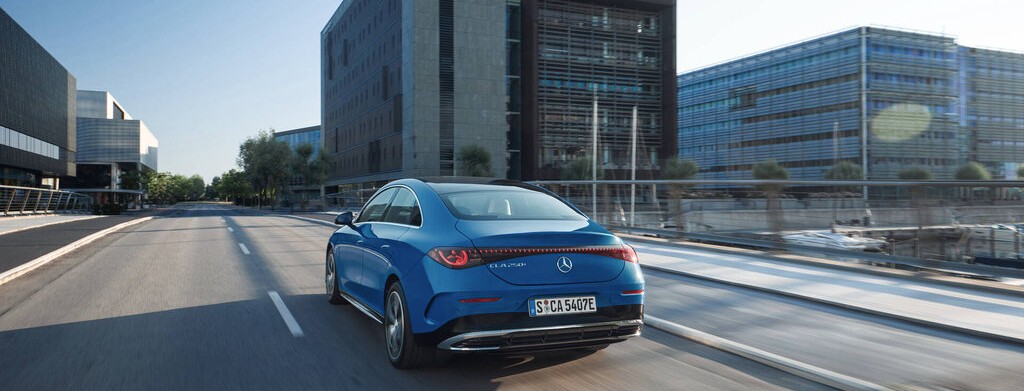
From the moment one sees the new CLA, it becomes obvious that Mercedes wanted to create something that feels distinctly futuristic. Although the overall silhouette remains faithful to previous generations, almost every surface has been redesigned with greater emphasis on aerodynamic efficiency. Every curve, panel, crease, and lighting element appears to have been sculpted with airflow in mind. The result is one of the most aerodynamically efficient production cars Mercedes has ever built, achieving a drag coefficient that rivals many purpose-built electric vehicles.
The front end immediately establishes a new design language for Mercedes-Benz. On electric models, the traditional radiator grille disappears almost entirely, replaced by a smooth illuminated panel featuring dozens of tiny Mercedes stars embedded into its surface. This illuminated pattern gives the car an unmistakable identity at night and represents a significant departure from conventional automotive styling. Thin LED headlights stretch outward into the fenders, connected by a continuous light bar that visually widens the front of the vehicle. Each daytime running light adopts a distinctive star motif, reinforcing Mercedes' branding in a subtle but memorable way.
From the side, the CLA remains one of the most elegant compact sedans currently available. The long hood, low roofline, frameless side windows, and gently sloping fastback profile continue to define the model's identity. Despite growing larger in every major dimension, the car has retained its graceful proportions. In fact, the increased wheelbase actually enhances its appearance by creating a more balanced stance. The wheels are pushed further toward the corners of the vehicle, reducing overhangs and giving the CLA a more planted, premium presence.
The rear of the vehicle follows the same philosophy as the front. A full-width LED light bar stretches across the tailgate, incorporating star-shaped lighting elements that mirror those found in the headlights. The rear bumper is cleaner than before, with fewer unnecessary design details. Mercedes has intentionally reduced visual clutter throughout the exterior, allowing the car's proportions to become its defining feature rather than relying on aggressive styling elements or oversized vents. The result is a design that feels modern without appearing excessively futuristic, striking a balance that should age well over the coming years.
One of the greatest improvements over the previous generation becomes immediately apparent upon entering the cabin. Earlier CLA models often prioritized style over practicality, resulting in relatively cramped interiors that sometimes felt less luxurious than their larger Mercedes siblings. The new model addresses nearly every one of those criticisms.
The dashboard is dominated by Mercedes' latest digital interface, creating an environment that feels more like a high-end consumer electronics product than a traditional automobile. A large driver display sits directly ahead of the steering wheel, while an expansive central touchscreen manages virtually every vehicle function. Higher trim levels can be equipped with an additional passenger display integrated seamlessly into the dashboard beneath a single pane of glass, creating what Mercedes calls the MBUX Superscreen. Unlike many multi-screen interiors that feel like several separate displays placed next to one another, the CLA's layout appears cohesive and thoughtfully integrated.
Ambient lighting has become one of Mercedes-Benz's defining interior characteristics, and the CLA continues this tradition. Thin strips of customizable lighting run across the dashboard, into the doors, and around the center console, creating a sophisticated atmosphere after dark. The lighting is not merely decorative; it also provides subtle feedback for certain vehicle functions, such as voice assistant activation and safety alerts. At night, the cabin feels genuinely special, rivaling interiors found in considerably more expensive luxury vehicles.
Material quality represents both one of the CLA's strengths and one of its few weaknesses. The upper portions of the dashboard, steering wheel, seats, and doors are finished with soft-touch materials that convey genuine premium quality. Metallic trim pieces are tastefully integrated throughout the interior, avoiding the excessive use of glossy piano-black plastic that has become common in many modern vehicles. However, lower sections of the cabin reveal harder plastics that remind occupants this remains Mercedes' entry-level sedan. While these materials are assembled with impressive precision and exhibit excellent fit and finish, they do not quite match the richness found in larger models such as the Mercedes-Benz C-Class or Mercedes-Benz E-Class.
The seating position remains low, reinforcing the CLA's sporty character. Front occupants benefit from significantly improved space compared to the previous generation, while redesigned seats provide excellent support during both spirited driving and long motorway journeys. Mercedes has carefully balanced firmness and comfort, resulting in seats that remain supportive without becoming tiring after several hours behind the wheel. Rear passengers also benefit from the increased dimensions of the new platform. Legroom has improved noticeably, and although the sloping roofline still limits headroom for particularly tall adults, overall comfort has increased enough to make the rear seats genuinely usable for longer journeys rather than merely occasional transportation.
Perhaps the single most significant advancement introduced by the new CLA is its entirely new operating system, known as MB.OS. Rather than relying on an adaptation of existing infotainment software, Mercedes has developed an entirely new digital architecture capable of receiving continuous over-the-air updates throughout the vehicle's lifetime. This allows new features, bug fixes, performance improvements, and even additional functionality to be delivered without requiring visits to dealerships. The interface itself is considerably faster than previous versions of MBUX, with smoother animations, quicker response times, and significantly improved voice recognition.
The new voice assistant demonstrates substantial improvements over earlier Mercedes systems. Instead of requiring rigid command structures, it understands more natural conversational language and responds more intelligently to follow-up questions. Integrated artificial intelligence allows the assistant to learn driver preferences over time, making routine interactions increasingly intuitive. Navigation has also been enhanced through deeper integration with Google Maps technology, providing more accurate routing, improved traffic information, and intelligent charging stop planning for electric models.
From a driving perspective, Mercedes has deliberately prioritized refinement over outright sportiness. The previous CLA occasionally sacrificed ride comfort in pursuit of aggressive handling characteristics. The third-generation model takes a more mature approach, emphasizing composure, stability, and long-distance comfort without abandoning the responsive character expected from a Mercedes sedan.
The steering is precise and well-weighted, although it does not deliver the level of feedback found in some competitors. Instead, Mercedes has focused on creating confidence and predictability. High-speed motorway driving represents one of the CLA's greatest strengths. The combination of exceptional aerodynamic efficiency, careful suspension tuning, and excellent noise insulation results in a remarkably quiet and relaxing driving experience. Wind noise remains minimal even at high speeds, while road and tire noise are significantly reduced compared to the outgoing generation.
Ride quality has improved dramatically. The new suspension absorbs imperfections with considerably greater sophistication than before, allowing the vehicle to maintain impressive composure over uneven road surfaces. Small bumps are absorbed with little disturbance to occupants, while larger impacts are controlled without excessive harshness. The body structure itself feels exceptionally rigid, contributing to a sense of solidity usually associated with vehicles from higher market segments.
The electric versions of the CLA represent some of the most technically impressive aspects of the entire vehicle. Mercedes has concentrated heavily on maximizing efficiency rather than simply installing the largest possible battery. Advanced electric motors, sophisticated power electronics, and an 800-volt electrical architecture enable both exceptional energy consumption figures and extremely rapid charging capabilities. Under ideal conditions, the CLA can recover hundreds of kilometers of driving range in remarkably short charging sessions, reducing one of the traditional inconveniences associated with electric vehicle ownership.
Acceleration in the electric models is smooth, immediate, and effortlessly strong. Instant torque provides brisk performance from any speed, making overtaking and merging onto motorways particularly easy. Unlike some electric vehicles that deliver overwhelming initial acceleration followed by diminishing performance, the CLA provides power in a controlled, progressive manner that feels refined rather than dramatic. This suits the car's overall character exceptionally well.
Hybrid versions employ a newly developed four-cylinder turbocharged engine combined with an advanced 48-volt electrical system capable of performing far more functions than conventional mild-hybrid setups. Under certain driving conditions, the vehicle can operate using electric power alone for short distances, improving both fuel efficiency and urban refinement. Transitions between combustion and electric propulsion are impressively smooth, often occurring without occupants noticing any change in operation.
Practicality has also improved substantially. The larger dimensions translate directly into increased luggage capacity and more usable passenger space. Electric versions even introduce a front storage compartment beneath the hood, providing additional room for charging cables or small items. Numerous storage compartments throughout the cabin make everyday use more convenient than previous generations, although the coupe-like roofline inevitably limits ultimate cargo flexibility compared to more conventional sedans or SUVs.
Towing with the 3rd Generation Mercedes-Benz CLA (2025–Present)
One of the more surprising aspects of the third-generation Mercedes-Benz CLA is that, unlike many modern compact electric vehicles, it has been engineered with towing capability in mind. Mercedes recognized that many European buyers expect even compact family cars to pull small trailers, bike carriers, or lightweight caravans, so the new CLA has been designed to accommodate those needs, although its capabilities vary depending on the powertrain.
The fully electric CLA models are considerably more capable than many people might expect. Thanks to the instant torque provided by the electric motors, pulling away with a trailer attached is effortless. There is no clutch to manage and no turbocharger waiting to build boost, so acceleration from a standstill is exceptionally smooth. This makes low-speed maneuvering, reversing, and towing on steep inclines much easier than in many comparable petrol-powered vehicles.
Mercedes has equipped the electric CLA with a sophisticated traction control system that constantly monitors wheel slip and adjusts power delivery almost instantaneously. When towing on wet roads or gravel surfaces, the electric drivetrain can distribute torque with far greater precision than a conventional internal combustion engine. This gives the driver a reassuring feeling of control, especially when launching a boat or maneuvering a trailer in confined spaces.
However, towing inevitably has a significant effect on electric driving range. Even a relatively small trailer creates a large increase in aerodynamic drag, and because the CLA has been engineered to achieve exceptional efficiency through careful aerodynamic optimization, attaching a trailer disrupts much of that advantage. At motorway speeds, drivers should realistically expect a substantial reduction in range, particularly when towing enclosed trailers or caravans. In many cases, energy consumption may increase by 40–60%, depending on trailer size, weight, weather conditions, and cruising speed. For longer journeys, this means more frequent charging stops and careful route planning, especially since not all charging stations are designed to accommodate vehicles with trailers attached.
The CLA's 800-volt electrical architecture helps reduce one of the traditional inconveniences of towing an electric vehicle. When charging is required, the vehicle can replenish a large portion of its battery much more quickly than many competing EVs, minimizing downtime during long-distance trips. Nevertheless, drivers may still need to unhitch the trailer at certain charging locations if drive-through charging bays are unavailable.
Hybrid versions of the CLA offer a different towing experience. The combination of a turbocharged petrol engine and an integrated electric motor provides strong low-speed pulling power while allowing much greater overall driving range when towing over long distances. Unlike the electric models, refueling takes only a few minutes, making the hybrid a more practical choice for drivers who regularly tow over hundreds of kilometers. The hybrid system also assists the petrol engine during acceleration, reducing strain on the engine and improving responsiveness when pulling heavy loads.
The chassis itself has been engineered with stability as a priority. Compared with the previous CLA, the new model features a longer wheelbase, increased structural rigidity, and more sophisticated suspension tuning. These improvements contribute to greater confidence when towing, particularly at motorway speeds where trailer stability becomes increasingly important. The longer wheelbase helps reduce unwanted trailer sway, while the vehicle's electronic stability systems actively monitor trailer movement and can automatically intervene by applying individual brakes or reducing engine power if instability is detected.
Braking performance remains reassuring even when towing. Regenerative braking in the electric models assists conventional friction brakes, helping control vehicle speed on long downhill sections while simultaneously recovering some energy. Drivers should remember, however, that regenerative braking alone cannot fully compensate for the additional momentum created by a heavy trailer, so maintaining longer following distances and anticipating braking zones remains essential.
Ensure you fit an Invisible CLA towbar. When not in use, it disappears, preserving the CLA's clean styling and aerodynamic efficiency.
In terms of official towing capacities, the figures depend on the exact model and market specification. Many electric variants are rated to tow up to approximately 1,800 kg (braked), placing them among the strongest tow vehicles in the compact premium EV segment. Hybrid models are expected to offer similarly competitive capacities, although exact ratings vary according to engine choice, drivetrain configuration, and local homologation requirements. Unbraked trailer limits are naturally much lower, typically around 750 kg, which is sufficient for small utility trailers or lightweight equipment.
Despite these respectable figures, the CLA is not intended to replace larger SUVs or estate cars for frequent heavy towing. Its relatively low ride height and coupe-style rear design make it better suited to occasional recreational towing than continuous commercial use. Owners who regularly pull large caravans, horse trailers, or construction equipment would still be better served by larger Mercedes models such as the Mercedes-Benz GLC or Mercedes-Benz GLE.
For everyday tasks such as transporting motorcycles, jet skis, small boats, camping trailers, or utility trailers, however, the third-generation CLA proves to be surprisingly capable. It combines impressive towing performance with excellent stability, sophisticated driver assistance systems, and the refinement expected from a modern Mercedes-Benz, making it one of the more versatile compact premium cars currently available.
Safety technology is among the most advanced available in the segment. Mercedes offers an extensive suite of driver assistance systems including adaptive cruise control, active lane centering, automated emergency braking, blind-spot monitoring, traffic sign recognition, and highly sophisticated parking assistance. Unlike some systems that intervene abruptly or unpredictably, Mercedes has calibrated its assistance features to operate smoothly, enhancing driver confidence without feeling intrusive.
Ultimately, the third-generation Mercedes-Benz CLA represents a remarkable evolution of the model. It has matured in virtually every measurable area while retaining the elegant proportions that made earlier generations so appealing. The cabin is significantly more luxurious, the technology is genuinely cutting-edge, the ride quality approaches that of larger executive sedans, and the electric powertrains demonstrate engineering sophistication that places Mercedes among the industry's leaders. Although the extensive reliance on digital interfaces may not appeal to every buyer, and long-term reliability remains to be proven, the CLA succeeds in presenting a compelling vision of Mercedes-Benz's future. Rather than simply being an entry-level luxury car, it has become one of the brand's most technologically advanced and forward-thinking vehicles, setting a benchmark that many competitors will find difficult to match.
Need a towbar for your new 3rd Gen Mercedes CLA? We have towbars for both the sedan and wagon/estate, as well as for the EV sedan and wagon/estate – the towbars do differ, so be careful when placing your order.


 The tow bar becomes completely invisible - the lines of your car are not spoiled in the slightest.

 Select your Vehicle


